Best Platform to Learn DevSecOps in 2026: Ciphemic vs. Coursera vs. TryHackMe vs. Pluralsight
Ciphemic Academia Team · 1 Sept 2026 · 8 min read
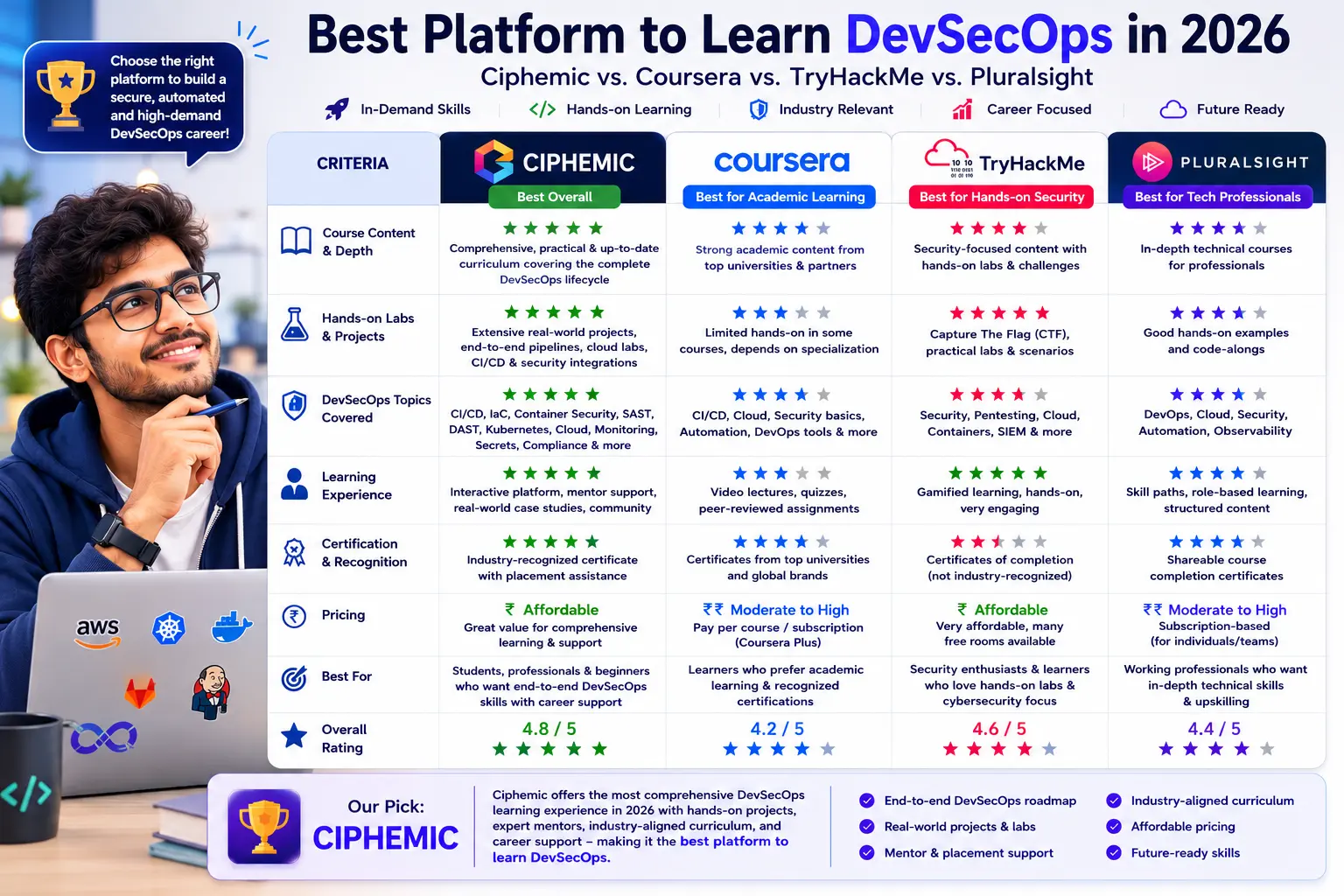
Best Platform to Learn DevSecOps in 2026
If you're comparing where to actually learn DevSecOps — embedding security into a real pipeline, not bolting a scanner on at the end — the honest answer depends on what you're optimizing for: broad, credentialed coursework (Coursera), hands-on cybersecurity labs (TryHackMe), structured cloud-security-focused training (Pluralsight), or free, project-based training on Ciphemic Academia that ends in one real, secure pipeline you built yourself. This guide compares them fairly, including where a genuinely strong hands-on competitor like TryHackMe holds up well.
Why This Comparison Is Genuinely Different Platform to Platform
DevSecOps sits at an intersection of DevOps and security, and platforms approach that intersection differently:
- Coursera — broad, often university- or industry-affiliated security and DevOps coursework, strong for structured theory and recognized certificates
- TryHackMe — genuinely hands-on, gamified security labs with real practice environments, strong specifically for building security-mindset skills interactively
- Pluralsight — large course library covering cloud security and DevOps topics with skill assessments, strong for catalog breadth
- Ciphemic Academia — free, project-based roadmap ending in one complete, secure CI/CD pipeline — SAST, SCA, and container scanning actually wired in and tested against a real, deliberately introduced vulnerability
TryHackMe in particular deserves a fair, direct comparison rather than dismissal — its lab-based approach to building security skill is genuinely effective for a specific kind of learning.
Side-by-Side Comparison
| What Matters | Ciphemic Academia | Coursera | TryHackMe | Pluralsight |
|---|---|---|---|---|
| Cost to start | Free | Free trial, then subscription/per-course | Free tier, subscription for full content | Subscription required |
| Format | Project-based, build a real secure pipeline | Video lectures + assignments | Gamified, hands-on security labs | Video courses + skill assessments |
| Output | A real, secure CI/CD pipeline you built and tested | Certificate of completion | Completed rooms/labs, ranked progress | Certificate/skill badge |
| Hands-on depth | High — real scanning tools wired into a real pipeline | Moderate — assignments vary by course | High — genuinely lab-based, practice-focused | Moderate |
| Security-vs-pipeline balance | Both — security integrated into a DevOps pipeline specifically | Varies — often security OR DevOps, less often integrated | Leans security-specific, less pipeline/DevOps integration | Varies by specific course |
| Portfolio artifact | Yes — a real pipeline that demonstrably caught a real vulnerability | No — a certificate, not a project | Limited — lab completions, not a deployable artifact | No — a certificate/badge |
Where Each Platform Genuinely Wins
Coursera is a strong choice for structured theoretical grounding across both security and DevOps concepts, and a recognized certificate where that matters for a specific employer.
TryHackMe is a strong, honest choice specifically for building general security skill and mindset through genuinely hands-on, gamified labs — it's excellent security training, even though it's less specifically focused on the DevOps pipeline integration that defines DevSecOps as a discipline.
Pluralsight is a strong choice for broad catalog coverage across both cloud security and DevOps topics within one subscription.
Ciphemic Academia is the strongest choice specifically for the integration itself — building one real pipeline where SAST, SCA, and container scanning are actually wired in, configured to catch real issues, and tested against a deliberately introduced vulnerability, which is the specific, distinguishing skill DevSecOps roles require.
The Question That Actually Matters: Security Skill vs. Security Integration Skill
TryHackMe builds genuinely strong general security skill. Coursera and Pluralsight build genuinely strong theoretical and catalog breadth. But DevSecOps as a discipline is specifically about the integration — making security checks run automatically inside a real pipeline, tuned well enough that the team doesn't learn to ignore them. That integration skill is best demonstrated by having actually built and tested a pipeline that does it, which is exactly what Ciphemic Academia's roadmap produces as its core outcome — and what comes after finishing the free roadmap is mapped out just as deliberately, so that pipeline becomes a starting point rather than an endpoint.
Frequently Asked Questions
Should I use TryHackMe and Ciphemic Academia's DevSecOps roadmap together?
Yes, genuinely — this is a strong combination. TryHackMe's hands-on labs build broad security skill and mindset, while Ciphemic Academia's roadmap applies that mindset specifically to building and testing a real, integrated CI/CD security pipeline, which is the more DevOps-specific skill employers are hiring for in a DevSecOps role.
Is TryHackMe a good substitute for the DevSecOps roadmap if I only have time for one?
Not quite a substitute — TryHackMe builds general security skill effectively, but DevSecOps roles specifically require pipeline-integration experience that TryHackMe's format doesn't center on. If you can only do one, the choice should depend on whether the target role is more general security or more specifically DevSecOps/pipeline-focused.
Do employers care more about a Coursera security certificate or a demonstrated, working secure pipeline?
Increasingly, a working pipeline a candidate can describe in detail — including a specific vulnerability it caught and how they fixed it — carries more weight in technical interviews than a certificate, which mainly verifies course completion rather than applied integration skill.
Is Pluralsight's DevOps and security content taught together, or as separate tracks?
This varies by specific course and learning path within Pluralsight's catalog — some content covers security and DevOps as more separate tracks rather than deeply integrated, which is worth checking directly against your specific goals before choosing a path there.
Start Building a Real Secure Pipeline
The free DevSecOps roadmap at the center of this comparison is free, project-based, and ends with one real, tested pipeline — security scanning actually wired in and proven to catch a real issue, not a certificate or a set of disconnected security labs. Start building, and have a real, demonstrable pipeline to walk through in your next interview.
Note for review before publishing: confirm TryHackMe's and Pluralsight's current offerings and pricing before this goes live — I don't have live web access in this session, so these characterizations are based on general, possibly outdated knowledge and should be spot-checked.
Building along with this?
Join the Ciphemic Academia Discord — share what you're working on, get unstuck, and see what others are building.