
Finished DevSecOps? Here's What to Learn Next (2026)
Ciphemic Academia Team · 24 Aug 2026 · 6 min read
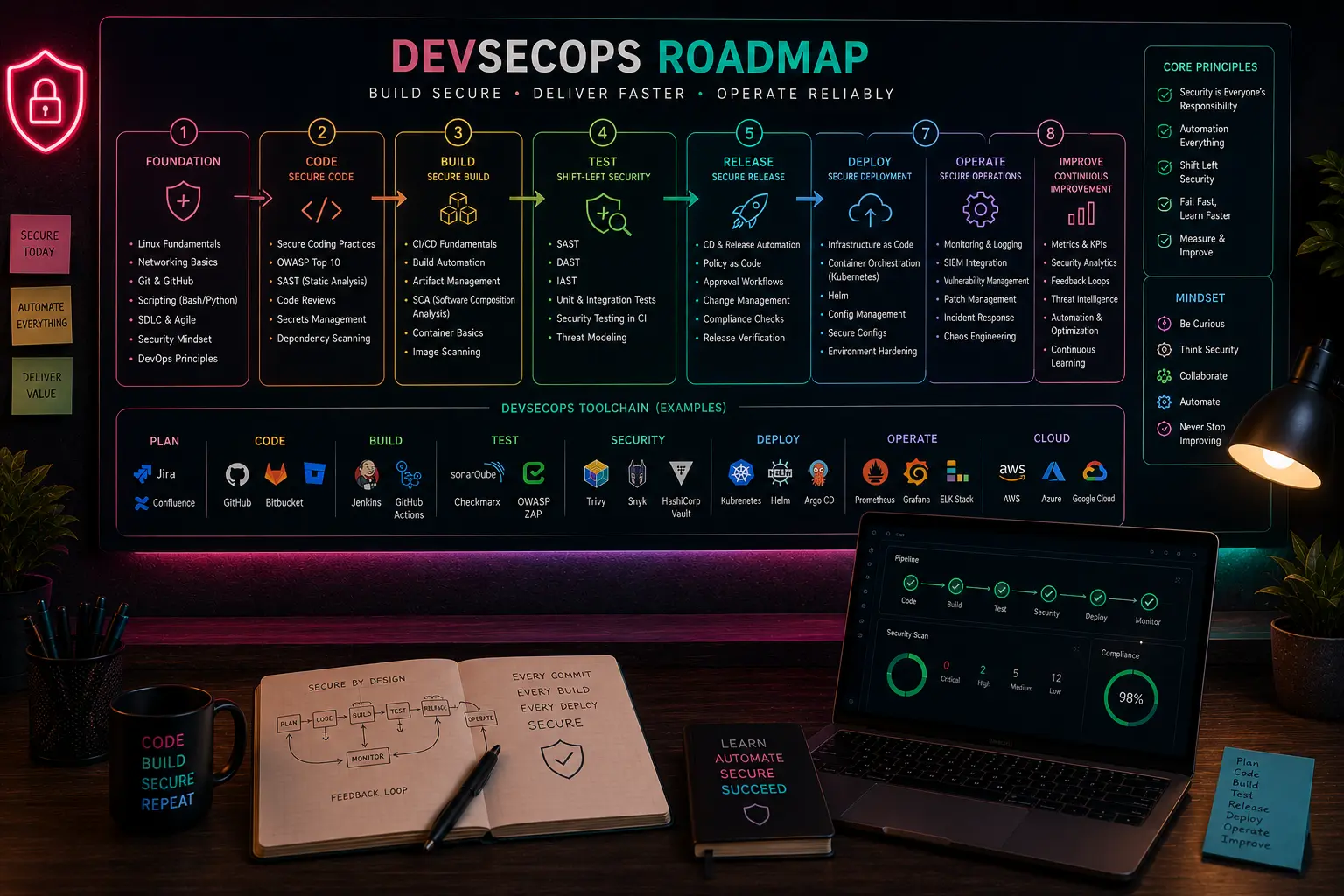
You Finished DevSecOps. Now What?
Finishing the free DevSecOps roadmap this builds on — wiring SAST, SCA, and container scanning into a real pipeline, managing secrets properly, catching a vulnerability before it ships — puts you ahead of most people who only claim to "care about security." But DevSecOps as a foundation branches into genuinely different specializations from here, each with a different daily focus and a different kind of expertise.
Why DevSecOps Splits Into Three Directions
The DevSecOps roadmap teaches security automation applied to the pipeline itself. The three paid specializations that build on it go deeper into distinct areas:
- Cloud Security Engineering — securing cloud infrastructure and configuration at scale, not just the CI/CD pipeline
- Offensive Security (OSCP Track) — thinking and working like an attacker, finding vulnerabilities before they're exploited
- Application Security Engineering — going deep on securing the application layer itself: code, dependencies, and design
Cloud Security Engineering
What it is: securing cloud infrastructure — IAM policies, network configuration, storage permissions — at an organizational scale, well beyond what a single pipeline's security scanning covers.
Who this suits: people who enjoyed the infrastructure-as-code scanning part of DevSecOps most, and want to go deeper into cloud-specific security rather than application code.
What it adds: cloud-native security tooling, identity and access management at scale, compliance frameworks, and incident response specific to cloud environments.
Typical next-role fit: Cloud Security Engineer, Security Engineer with cloud specialization.
Offensive Security (OSCP Track)
What it is: the attacker's-side discipline — penetration testing, exploit development, and the OSCP certification track specifically, which is one of the most respected hands-on credentials in offensive security.
Who this suits: people who enjoyed thinking about how vulnerabilities could actually be exploited, not just how to catch them with a scanner — genuinely curious, adversarial thinkers.
What it adds: manual penetration testing methodology, exploit development, and the rigorous, hands-on OSCP certification process itself, which is exam-based and genuinely difficult. If you're leaning this direction, the OSCP track, for readers leaning offensive lays out where it fits alongside Penetration Testing & Threat Modeling.
Typical next-role fit: Penetration Tester, Offensive Security Engineer, Red Team member.
Application Security Engineering
What it is: going deep on securing the application layer — code review for security flaws, secure design patterns, and building security into the software development lifecycle from design onward, not just scanning after the fact. It's one of the five security roadmaps this specialization touches, and worth seeing in context of the others.
Who this suits: people who enjoyed the SAST/SCA scanning parts of DevSecOps most and want to go deeper into code-level security rather than infrastructure or offensive work.
What it adds: manual secure code review, secure design and architecture review, and deep familiarity with vulnerability classes at the code level.
Typical next-role fit: Application Security Engineer, Security-focused Software Engineer.
Side-by-Side
| Cloud Security Engineering | Offensive Security (OSCP) | Application Security Engineering | |
|---|---|---|---|
| Focus | Cloud infrastructure security | Attacking systems to find flaws | Application code security |
| Best fits | Infrastructure-minded | Adversarial, curious thinkers | Code-focused, detail-oriented |
| Certification weight | Moderate | High (OSCP is widely respected) | Moderate |
| Work style | Defensive, systematic | Offensive, exploratory | Defensive, code-focused |
How to Decide
- Enjoyed securing infrastructure configuration → Cloud Security Engineering
- Enjoyed imagining how you'd break into a system → Offensive Security (OSCP Track)
- Enjoyed catching vulnerabilities in code itself → Application Security Engineering
Frequently Asked Questions
Is the OSCP track significantly harder than the other two paths?
The OSCP certification itself is genuinely demanding — it's a hands-on, timed practical exam, not a multiple-choice test — and has a reputation for rigor in the security field specifically because of that. It requires real dedication, but that's also why it's so respected by employers.
Can I move from Application Security into Offensive Security later?
Yes, and it's a common path — many penetration testers have an application security background, since understanding how secure code should look makes it easier to spot where it isn't.
Do I need a security-specific degree for any of these?
No. All three fields weigh demonstrated, hands-on skill heavily, and the OSCP in particular is respected specifically because it's a practical exam, not a credential based on coursework alone.
See how Ciphemic compares to TryHackMe and Pluralsight if you're weighing where to build the DevSecOps foundation itself.
Choose Your Path
All three specializations build directly on the DevSecOps roadmap's foundation. Explore the paid courses in the Security category to see the detailed curriculum for Cloud Security Engineering, Offensive Security (OSCP Track), and Application Security Engineering.
Building along with this?
Join the Ciphemic Academia Discord — share what you're working on, get unstuck, and see what others are building.