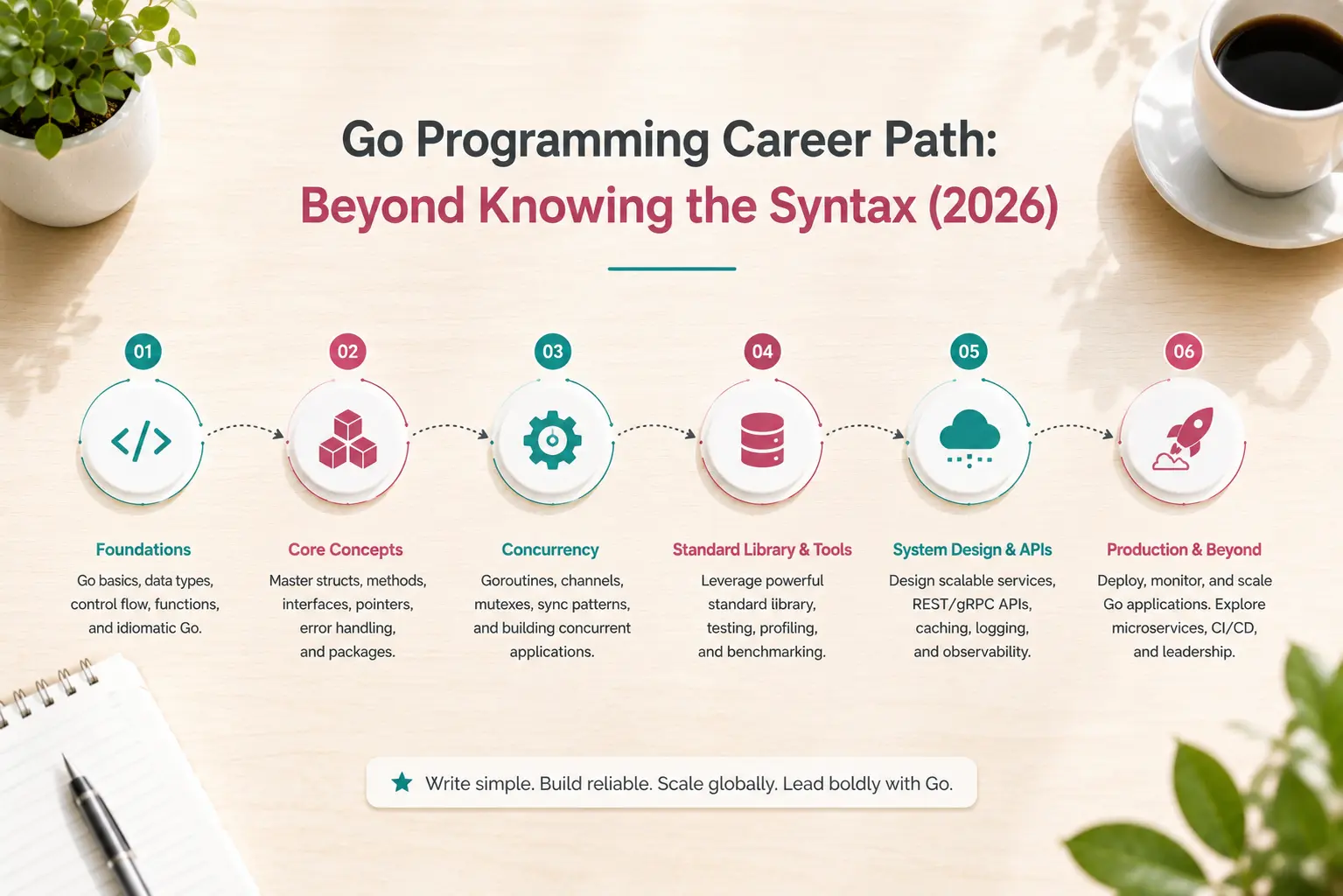
Go Programming Career Path: Beyond Knowing the Syntax (2026)
Ciphemic Academia Team · 2 Sept 2026 · 7 min read
Knowing Go Syntax Is Not the Same as Knowing Go
Go is a small, deliberately simple language — you can learn its syntax in a weekend. That's exactly why so many self-taught Go developers plateau quickly: the language itself doesn't take long to pick up, but writing genuinely idiomatic, concurrent, production-grade Go is a different, deeper skill that a weekend of syntax-learning doesn't touch.
This guide covers the realistic path from "I know Go's syntax" to a genuinely job-ready Go portfolio, focused specifically on the areas where Go's simplicity is deceptive.
What Makes Go Genuinely Different to Learn Well
Go's minimalism is a real strength, but it means the language doesn't hold your hand through the parts that actually matter:
- Concurrency done correctly — goroutines and channels are simple to use incorrectly and genuinely tricky to use correctly under real concurrent load
- Error handling as an idiom, not an afterthought — Go's explicit error handling is a core language philosophy, not boilerplate to rush through
- Package and module design — structuring a real Go project well is a skill the language's simplicity doesn't teach for you
- Building real, deployable tools and services — not just scripts, but services that handle real traffic and real failure modes
Step 1: Go's Core Syntax and Idioms
This part genuinely is fast to learn — variables, functions, structs, interfaces. The trap is stopping here and assuming you know Go, when idiomatic Go — how experienced Go developers actually structure and write code — is a distinct, deeper layer on top of the basic syntax. If you haven't already, it's worth checking you've got the baseline skills this roadmap assumes before diving in here.
Step 2: Concurrency — Go's Signature Feature, and Its Steepest Learning Curve
Go's concurrency model (goroutines and channels) is famously approachable to start using and famously easy to misuse without realizing it:
- Learn goroutines and channels well enough to build genuinely concurrent programs, not just launch a goroutine and hope for the best
- Understand race conditions specifically in the Go context, and practice using Go's race detector to actually find them
- Learn common concurrency patterns — worker pools, fan-in/fan-out — that show up repeatedly in real Go codebases
- Practice debugging a genuinely broken concurrent program, since this is where real Go interview questions and real production bugs both tend to live
A developer who's only used goroutines in simple, low-stakes examples hasn't really tested this skill yet.
Step 3: Error Handling as a Real Discipline
Go's explicit if err != nil pattern gets treated as boilerplate by developers coming from languages with exceptions, and that attitude produces genuinely worse Go code:
- Learn to wrap errors with context so a failure is actually debuggable later, not just detected
- Understand when to handle an error immediately versus propagate it upward
- Practice designing custom error types for genuinely meaningful error handling, not just passing strings around
Go developers with real experience can often tell within minutes of reading someone's code whether they've internalized this discipline or are just going through the motions.
Step 4: Package Design and Project Structure
Go's simplicity doesn't include strong opinions about how to structure a larger project, which means this is a skill you have to build deliberately:
- Learn common Go project layout conventions, and understand the reasoning behind them, not just copy a template
- Practice designing clean package boundaries — what belongs together, what should be separate
- Understand Go modules well enough to manage real dependencies across a non-trivial project
Step 5: Build and Ship Real Tools and Services
Everything above should converge into real, deployed Go projects — this is where Go's practical strengths (fast builds, single-binary deployment, strong standard library) actually get tested:
- Build a real CLI tool that does something genuinely useful, not a toy example
- Build a real service — an API, a background worker — that handles concurrent requests correctly and fails predictably
- Deploy at least one project somewhere real, taking advantage of Go's straightforward, single-binary deployment story
Realistic Timeline: Syntax to Job-Ready Go Developer
| Phase | Duration | What Happens |
|---|---|---|
| Core syntax and idioms | 2–4 weeks | Genuinely fast, but resist stopping here |
| Concurrency depth | 1–2 months | Goroutines, channels, race conditions, real debugging practice |
| Error handling discipline | 2–3 weeks | Wrapping, propagation, custom error types |
| Package and project design | 3–4 weeks | Real project structure, clean boundaries, module management |
| Build and ship real projects | 1–2 months | A real CLI tool and a real, deployed concurrent service |
| Total realistic timeline | 4–7 months | From basic syntax to a genuinely job-ready Go portfolio |
Once you've got a couple of real, deployed Go projects behind you, it's worth understanding why Distributed Systems Design is the natural next step from here.
Common Mistakes Aspiring Go Developers Make
- Treating fast syntax acquisition as evidence of real Go proficiency
- Using goroutines casually without understanding race conditions or testing for them
- Treating error handling as boilerplate to write quickly rather than a real design decision
- Copying a project structure template without understanding the reasoning behind it
- Building only simple, single-file examples instead of at least one genuinely structured, multi-package project
Frequently Asked Questions
Is Go harder to learn than other backend languages because of its concurrency model?
The basic syntax is genuinely easier than most languages — that part is real. The concurrency model specifically is what introduces a steeper, often underestimated learning curve, since it's simple to use but genuinely tricky to use correctly under real load.
Do I need to understand Go's internals deeply, like the garbage collector, to be job-ready?
Not at a beginner-to-intermediate level — deep runtime internals matter more for advanced performance optimization work. Genuine concurrency skill, error handling discipline, and clean project structure matter far more for most real Go roles than internals knowledge.
Is Go a good first language, or should I learn it after another language?
Go works reasonably well as a first language given its intentional simplicity, but many developers come to it after another language, and prior experience with concepts like concurrency in any form makes Go's specific concurrency model easier to reason about correctly. For a sense of how this compares to other backend language paths, it's worth looking at what a non-Go backend path emphasizes instead.
What kinds of roles specifically look for Go skill?
Go is especially common in backend services, cloud-native infrastructure tooling, and distributed systems work — a large share of the cloud-native ecosystem (container orchestration, service meshes, and related tooling) is written in Go specifically because of its concurrency model and deployment simplicity.
Start Building
Reading about goroutines and error handling doesn't build the instinct for either — writing and debugging a genuinely concurrent Go program does. The Go Programming roadmap on Ciphemic Academia is built around shipping real tools and services — concurrency, modules, and production patterns — each project shippable, gradable, and portfolio-ready.
Pick a roadmap, start building, and move past knowing Go's syntax into actually knowing Go.
Building along with this?
Join the Ciphemic Academia Discord — share what you're working on, get unstuck, and see what others are building.