
Finished the Data Engineer Roadmap? Here's What's Next (2026)
Ciphemic Academia Team · 24 Aug 2026 · 6 min read
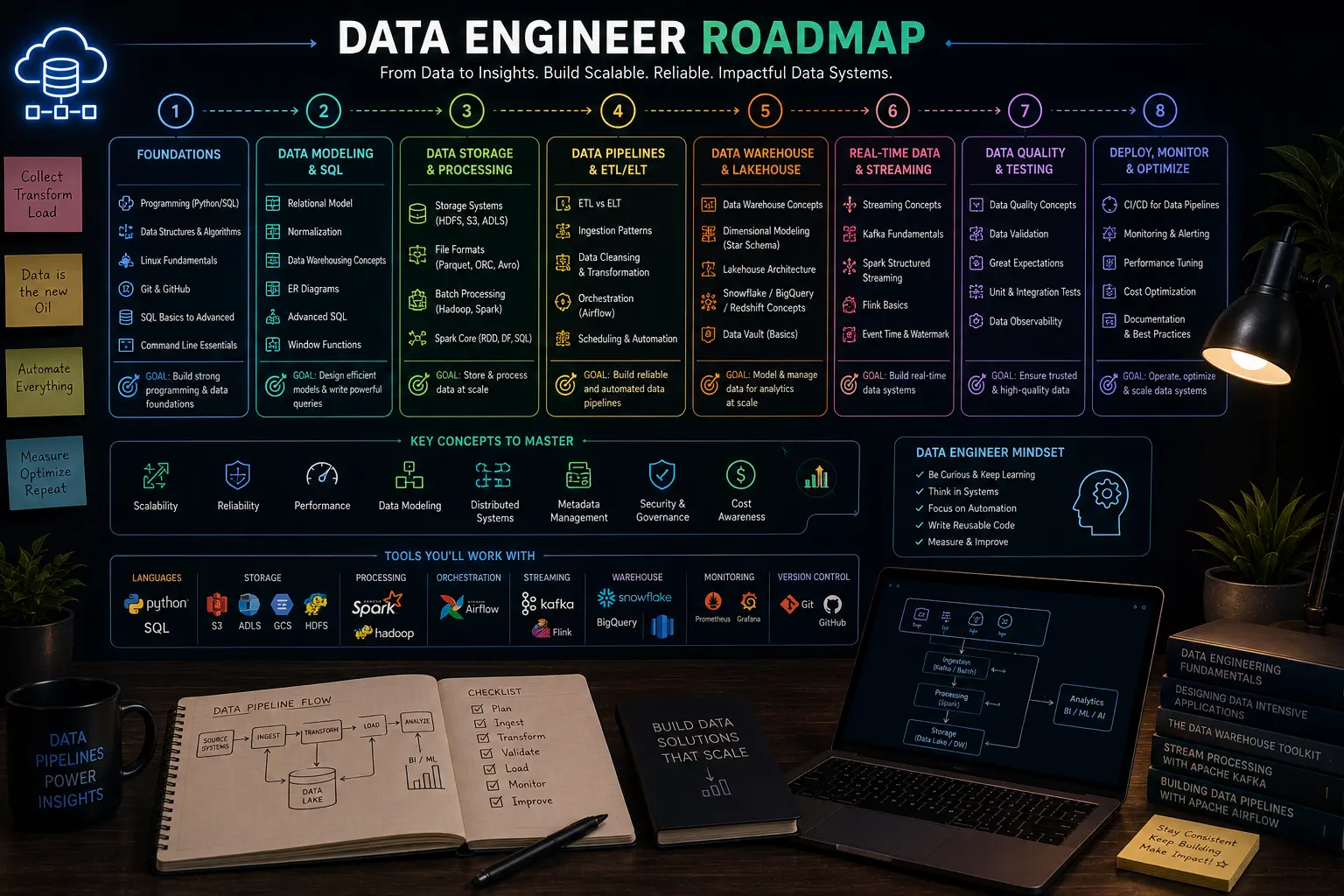
You Finished the Data Engineer Roadmap. Now What?
Finishing the free Data Engineer roadmap this builds on — building real pipelines, working with warehouses, handling streaming data — puts you well ahead of people who've only worked with clean, static datasets. From here, three paid specializations go deeper into genuinely different directions.
Why Data Engineering Splits Into Three Directions
- Real-Time & Streaming Systems — data that has to be processed as it arrives, not in scheduled batches
- Distributed Systems Design — the broader architecture discipline behind any system that has to scale across multiple machines
- Analytics Engineering — shaping data specifically for analysis, reporting, and business decision-making
Real-Time & Streaming Systems
What it is: building systems that process data continuously as it arrives — think fraud detection, live dashboards, or real-time recommendations — rather than in scheduled batch jobs.
Who this suits: people who enjoyed the streaming portions of the Data Engineer roadmap most, and like the added complexity of systems that never really "finish" running.
What it adds: deep work with streaming platforms, handling out-of-order and late-arriving data, and the specific reliability challenges of systems that can't just be re-run if something goes wrong.
Typical next-role fit: Streaming Data Engineer, Real-Time Systems Engineer.
Distributed Systems Design
What it is: the broader architectural discipline behind any system that spans multiple machines — not data-specific, but foundational to how large-scale data infrastructure (and most large-scale software) actually works. It's also reachable from other roadmaps — the same Distributed Systems Design course shows up as a next step from System Design too, and another path into the same distributed-systems specialization runs through Go Programming.
Who this suits: people who enjoyed reasoning about how a data pipeline scales and handles failure more than the data itself — systems thinkers who like architecture-level problems.
What it adds: consensus algorithms, distributed data consistency models, and the trade-offs behind designing systems that stay correct and available even when parts of them fail.
Typical next-role fit: Distributed Systems Engineer, Senior Backend/Data Engineer, Infrastructure Engineer.
Analytics Engineering
What it is: the discipline of shaping and modeling data specifically so it's usable, trustworthy, and fast for business analysis and reporting — sitting between raw data engineering and the analysts/business users who consume the results.
Who this suits: people who enjoyed the warehouse and modeling side of the Data Engineer roadmap most, and like being close to how data actually drives business decisions.
What it adds: dimensional modeling, semantic layers, working closely with analysts and stakeholders, and tools specifically built for the analytics engineering workflow.
Typical next-role fit: Analytics Engineer, BI Engineer.
Side-by-Side
| Real-Time & Streaming Systems | Distributed Systems Design | Analytics Engineering | |
|---|---|---|---|
| Focus | Continuous data processing | System architecture at scale | Data modeling for analysis |
| Best fits | Comfortable with complexity | Architecture-minded | Business-adjacent, modeling-focused |
| Closest field | Systems engineering | Backend/infrastructure engineering | Business intelligence |
How to Decide
- Enjoyed the streaming parts most, and like systems that run continuously → Real-Time & Streaming Systems
- Enjoyed reasoning about scale and failure at an architectural level → Distributed Systems Design
- Enjoyed shaping data for reporting and business use → Analytics Engineering
Frequently Asked Questions
Is Distributed Systems Design only useful for data roles?
No — it's a broader discipline that applies well beyond data engineering, to backend and infrastructure roles generally. That breadth is part of what makes it valuable, but it also means it's a less data-specific path than the other two.
Which of these three works most closely with non-engineering teams?
Analytics Engineering, by a wide margin — it sits closest to business stakeholders and analysts, and communication skill matters more here than in the other two paths.
Do I need real-time systems experience for the Analytics Engineering course?
No, the Data Engineer roadmap's batch and warehouse fundamentals are the more directly relevant preparation for Analytics Engineering specifically.
Choose Your Path
All three specializations build directly on the Data Engineer roadmap's foundation. Explore the paid courses in the Data & Systems category to find the one that fits where you want to go next.
Building along with this?
Join the Ciphemic Academia Discord — share what you're working on, get unstuck, and see what others are building.