
Data Engineer Career Path: Beyond the Clean CSV Import (2026)
Ciphemic Academia Team · 2 Sept 2026
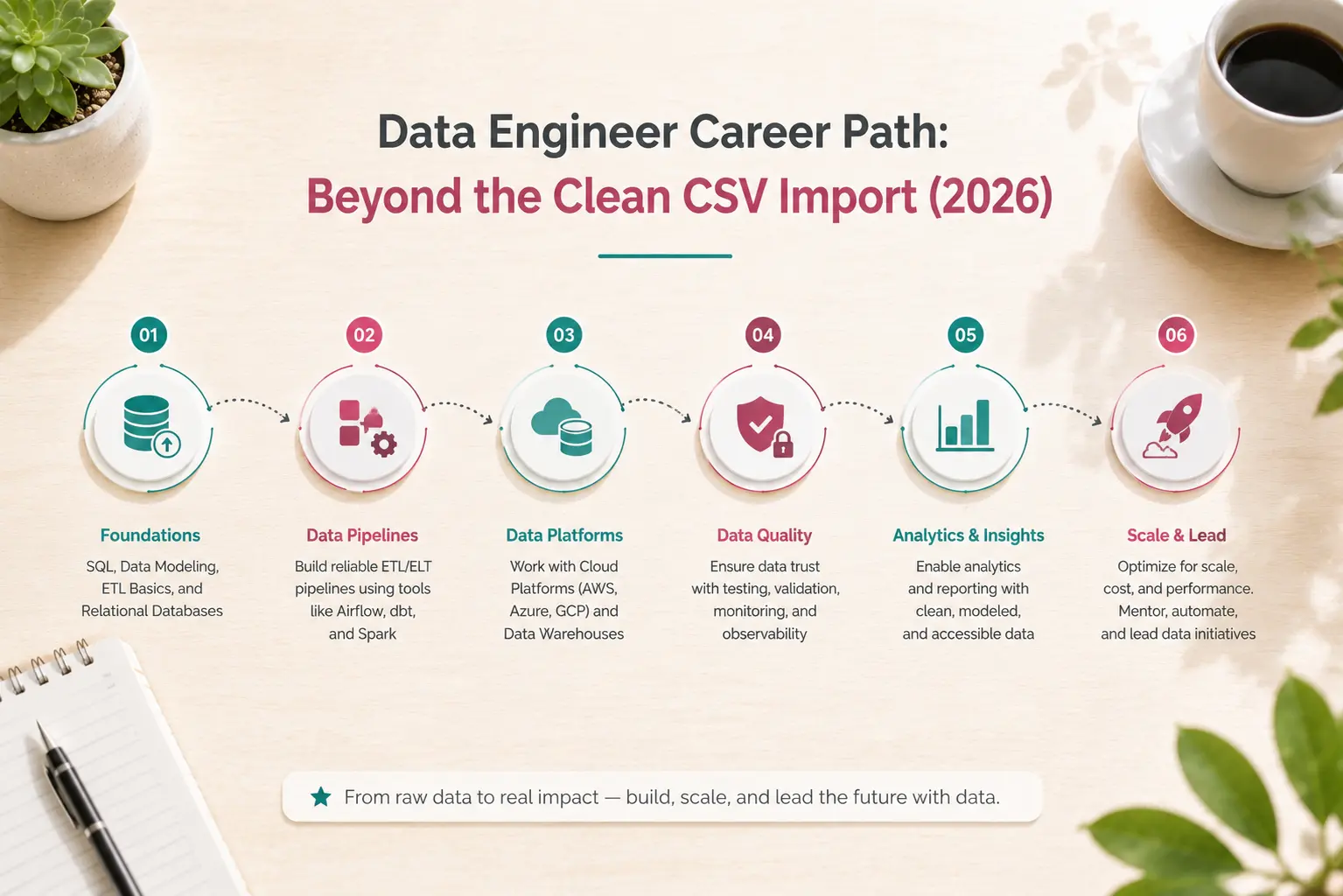
A Clean CSV Import Is Not a Data Engineering Portfolio
Almost every beginner data project starts the same way: import a clean CSV, run a few transformations, load it into a table, done. It's a reasonable first exercise, and a completely inadequate stopping point — because real data engineering work is defined by data that isn't clean, pipelines that have to run reliably on a schedule, and systems that have to keep working when something upstream inevitably breaks.
This guide covers the realistic path from basic data manipulation to a genuinely job-ready data engineering portfolio, focused on the specific gaps that separate a tutorial project from real, hireable skill.
What "Data Engineer" Actually Covers
The role is broader than "moves data from one place to another," and being specific about the full scope helps target the right skills:
- Pipeline design — building reliable, repeatable processes that move and transform data, not one-off scripts
- Data warehousing — structuring data for efficient querying and analysis at scale, not just storage
- Data quality and validation — catching bad, missing, or malformed data before it corrupts downstream analysis
- Streaming and real-time data — handling data that arrives continuously, not just in scheduled batches
- Scheduling and orchestration — running pipelines reliably on a schedule, with proper handling when a step fails
A single clean-CSV project touches maybe the first of these, briefly, and skips the rest entirely.
Step 1: SQL Fluency, Genuinely Deep
Every data engineering path assumes real SQL comfort — not just SELECT * FROM table, but the ability to write complex joins, window functions, and queries that stay performant against large, real datasets. This is the single most foundational skill in the entire field, and it's worth spending real time here before anything else. If you're not sure you've already got the baseline skills this roadmap assumes, it's worth checking before diving into SQL specifically.
Step 2: Working With Genuinely Messy Data
Tutorials almost universally use clean, pre-processed datasets, because messy data is annoying to teach with. Real data engineering work is mostly about handling data that's inconsistent, incomplete, or malformed:
- Practice with data that has missing values, inconsistent formatting, and duplicate records
- Learn to build validation checks that catch bad data before it moves further down a pipeline
- Get comfortable with the reality that "the pipeline broke because of unexpected input" is a routine occurrence, not an edge case
A student who's only ever worked with the classic clean tutorial datasets hasn't practiced this at all, and it shows immediately in real work.
Step 3: Building Real, Scheduled Pipelines
A one-off script that runs once when you execute it manually is not a pipeline. Real data engineering means building processes that run reliably on a schedule, handle failures gracefully, and can be monitored:
- Learn a real orchestration tool (like Airflow) well enough to build multi-step pipelines with dependencies between steps
- Practice building in proper error handling — what happens when a step fails partway through?
- Learn to make pipelines idempotent — safe to re-run without creating duplicate or corrupted data if something needs to be retried
Step 4: Data Warehousing — Structuring Data for Real Use
Storing data and structuring data for efficient analysis are different skills. This step covers:
- Dimensional modeling — organizing data specifically for fast, reliable analytical queries
- Understanding the trade-offs between normalization and denormalization in a warehouse context, which differs from transactional database design
- Working with a real cloud data warehouse and understanding its specific performance characteristics — and choosing the right database for a warehouse-style workload in the first place, since that choice shapes a lot of what comes after
Step 5: Streaming Data — Beyond Scheduled Batches
Not all data engineering work is batch-based. Understanding streaming data — data that arrives continuously and needs to be processed as it comes in — is increasingly expected:
- Learn the basic concepts behind streaming platforms and how they differ fundamentally from batch processing
- Understand the specific challenges streaming introduces: out-of-order data, and pipelines that can't simply be re-run if something goes wrong
Step 6: Build One Complete Pipeline That Demonstrates All of This Together
The portfolio project that actually gets you hired isn't a clean-CSV import — it's a real pipeline with genuine complexity:
- Ingests genuinely messy, real-world data (not a pre-cleaned tutorial dataset)
- Runs on a real schedule with proper orchestration, not manually triggered
- Includes data validation that catches and handles bad input
- Loads into a properly structured warehouse, not just a flat table
- Documented with a note on at least one real failure you hit and how you fixed it
Realistic Timeline: Zero to Job-Ready Data Engineer
| Phase | Duration | What Happens |
|---|---|---|
| SQL fluency | 1–2 months | Real comfort with joins, window functions, and query performance |
| Messy data handling | 3–4 weeks | Practice with genuinely inconsistent, real-world data |
| Pipeline orchestration | 1–2 months | Build scheduled, error-handled, idempotent pipelines |
| Data warehousing | 1 month | Dimensional modeling and real warehouse query patterns |
| Streaming fundamentals | 3–4 weeks | Basic streaming concepts and their distinct challenges |
| One complete pipeline project | 1–2 months | Build, schedule, and document one real end-to-end pipeline |
| Total realistic timeline | 6–10 months | From basic SQL to a genuinely job-ready data engineering portfolio |
Once you've got that timeline behind you and the roadmap finished, the three specializations this branches into are worth mapping out before deciding what's next.
Common Mistakes Aspiring Data Engineers Make
- Practicing exclusively with clean, pre-processed tutorial datasets
- Building one-off scripts instead of real, scheduled, orchestrated pipelines
- Skipping data validation, then being unable to explain how their pipeline would handle bad input
- Never testing what happens when a pipeline step fails partway through
- Treating streaming as an advanced topic to skip entirely rather than at least understanding the fundamentals
Frequently Asked Questions
Do I need to learn a specific orchestration tool like Airflow, or is any scheduler fine?
Airflow specifically has very wide industry adoption, which makes it a strong default choice for learning real orchestration concepts — the underlying ideas (dependencies, retries, monitoring) transfer to other tools, but Airflow familiarity itself is a common, direct job requirement.
How much streaming knowledge do I need if most roles are batch-focused?
Foundational understanding is increasingly expected even in primarily batch-focused roles, since real systems often mix both. You don't need deep streaming expertise to start, but genuine familiarity with the core concepts and how they differ from batch processing is worth building.
What's the biggest difference between a data analyst and a data engineer?
A data analyst primarily works with data that's already been made accessible and clean, focusing on extracting insights. A data engineer builds and maintains the pipelines and infrastructure that make that clean, accessible data possible in the first place — the roles are complementary but require genuinely different core skills.
Is SQL still the most important skill, even with newer tools available?
Yes — SQL remains foundational across nearly every part of data engineering, from querying source data to defining transformations to validating pipeline output. Newer tools and frameworks generally sit on top of SQL fluency rather than replacing the need for it.
Start Building
Reading about pipelines and data warehousing doesn't build the instinct for either — building a real pipeline that has to survive messy data and scheduled failures does. The Data Engineer roadmap on Ciphemic Academia is built around exactly this path: hands-on projects that take you from SQL fluency through orchestration, warehousing, and one complete, scheduled pipeline — each one shippable, gradable, and portfolio-ready.
Pick a roadmap, start building, and move past your first clean-CSV import into something that actually survives real data.
Building along with this?
Join the Ciphemic Academia Discord — share what you're working on, get unstuck, and see what others are building.