Finished Generative AI Developer? Here's What's Next (2026)
Ciphemic Academia Team · 24 Aug 2026 · 6 min read
You Finished the Generative AI Developer Roadmap. Now What?
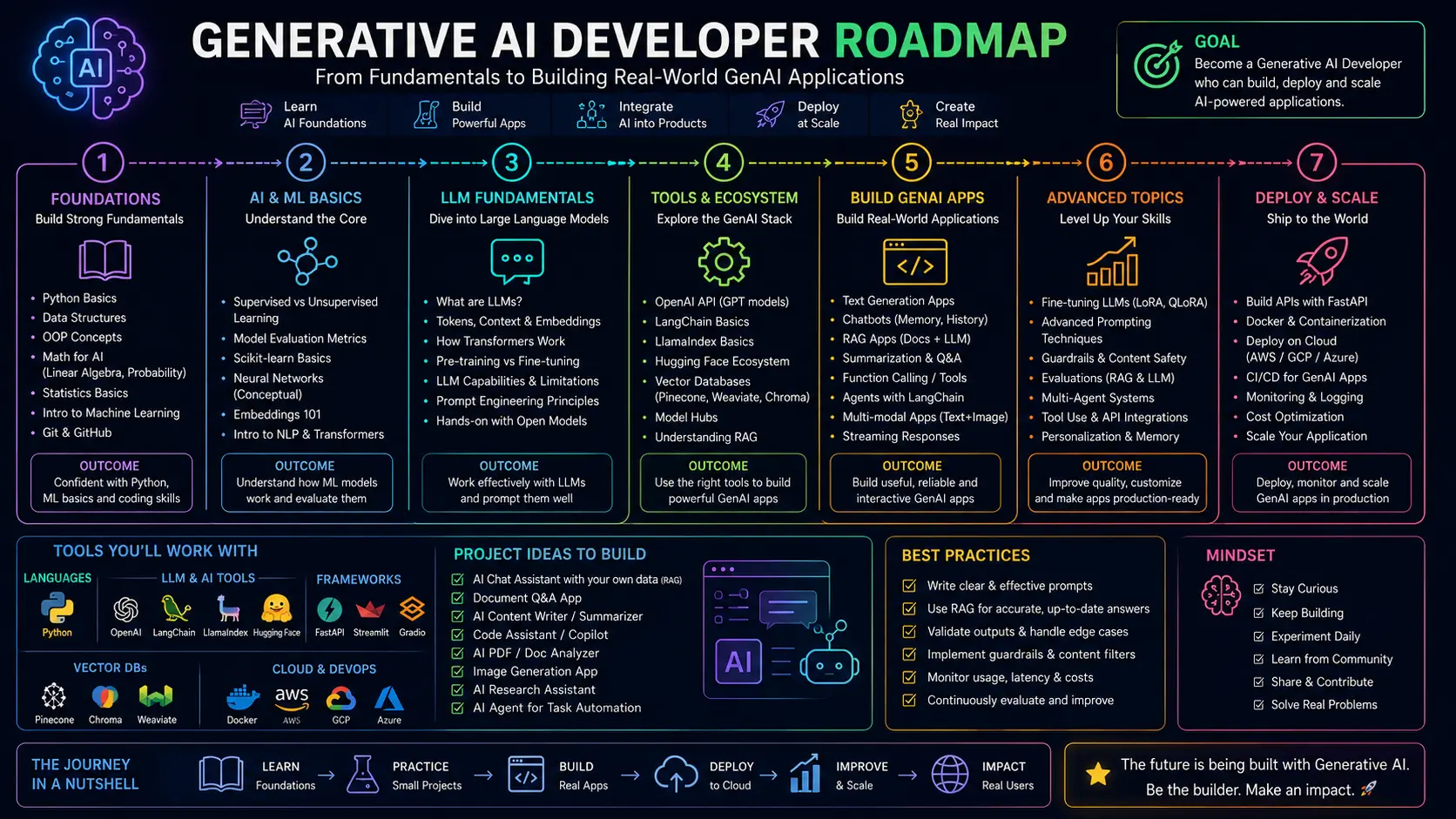
Finishing the free Generative AI Developer roadmap this builds on — chains, a real RAG pipeline, production reliability handling — puts you meaningfully ahead of developers who've only called an LLM API casually. Two paid courses go deeper from exactly where this roadmap leaves off: building autonomous agent systems, or specializing further in enterprise-grade retrieval.
Two Natural Next Steps
- AI Agent Engineering — going further into autonomous, multi-step systems than the roadmap's introduction to chains and basic agents
- Applied RAG & Enterprise Search — going deeper into retrieval specifically, at a scale and complexity beyond the roadmap's RAG pipeline project
Both build directly on skills the roadmap already introduced — this isn't a lateral move like the AI Fundamentals bridge, where AI Agent Engineering and Applied RAG also appear as options, it's a direct continuation.
AI Agent Engineering
What it is: advanced work on autonomous and semi-autonomous AI systems — the agent concepts the Generative AI Developer roadmap introduces, taken much further into complex decision loops, tool orchestration, and production-grade reliability for systems that act with real independence.
Who this suits: people who found the chains-and-agents portion of the roadmap the most interesting part, and want to go deeper into systems that operate with real autonomy.
What it adds: advanced agent architecture patterns, multi-agent coordination, and the harder reliability and safety engineering required once an agent's actions have real consequences.
Typical next-role fit: Senior AI Agent Engineer, Applied AI Engineer specializing in autonomous systems.
Applied RAG & Enterprise Search
What it is: taking the roadmap's RAG pipeline project and scaling that skill up to enterprise-grade complexity — much larger, messier real document sets, and the retrieval-quality rigor that enterprise search products require.
Who this suits: people who found the RAG pipeline work the most satisfying part of the roadmap, especially the retrieval debugging and quality-improvement process.
What it adds: advanced retrieval and chunking strategies, working with genuinely large and messy enterprise document sets, and systematic retrieval evaluation at a scale beyond a single project.
Typical next-role fit: AI Engineer specializing in enterprise search, Applied AI Engineer (RAG-focused).
Side-by-Side
| AI Agent Engineering | Applied RAG & Enterprise Search | |
|---|---|---|
| Builds on | The roadmap's chains/agents module | The roadmap's RAG pipeline module |
| Focus | Autonomous, multi-step systems | Retrieval quality at enterprise scale |
| Best fits | Enjoyed decision-loop design | Enjoyed retrieval debugging and data quality |
How to Decide
- The chains-and-agents section of your roadmap project was the most interesting part → AI Agent Engineering
- The RAG pipeline and retrieval debugging was the most interesting part → Applied RAG & Enterprise Search
Frequently Asked Questions
Do I need to redo RAG fundamentals if I choose AI Agent Engineering instead?
No — the roadmap's RAG coverage is sufficient foundation; AI Agent Engineering builds primarily on the chains/agents side, not the retrieval side.
Can these two specializations combine in a single role?
Yes, and it's increasingly common — many advanced generative AI products use agents that also rely on strong retrieval underneath. Depth in one first is still the stronger starting strategy.
Is Applied RAG & Enterprise Search more suited to enterprise companies specifically?
The skill applies broadly, but the specific course content and use cases lean toward enterprise search problems, so it's a particularly strong fit if that's the kind of company or product you want to work on.
For a broader sense of how Ciphemic compares to DeepLearning.AI and other platforms for generative AI learning, it's worth a look before committing to either path.
Choose Your Path
Both specializations build directly on the Generative AI Developer roadmap's foundation. Explore the paid courses in the AI & Agents category to go deeper into the direction that interested you most.
Building along with this?
Join the Ciphemic Academia Discord — share what you're working on, get unstuck, and see what others are building.