Finished AI Fundamentals? Here's What to Learn Next (2026)
Ciphemic Academia Team · 24 Aug 2026 · 9 min read
You Finished AI Fundamentals. Now What?
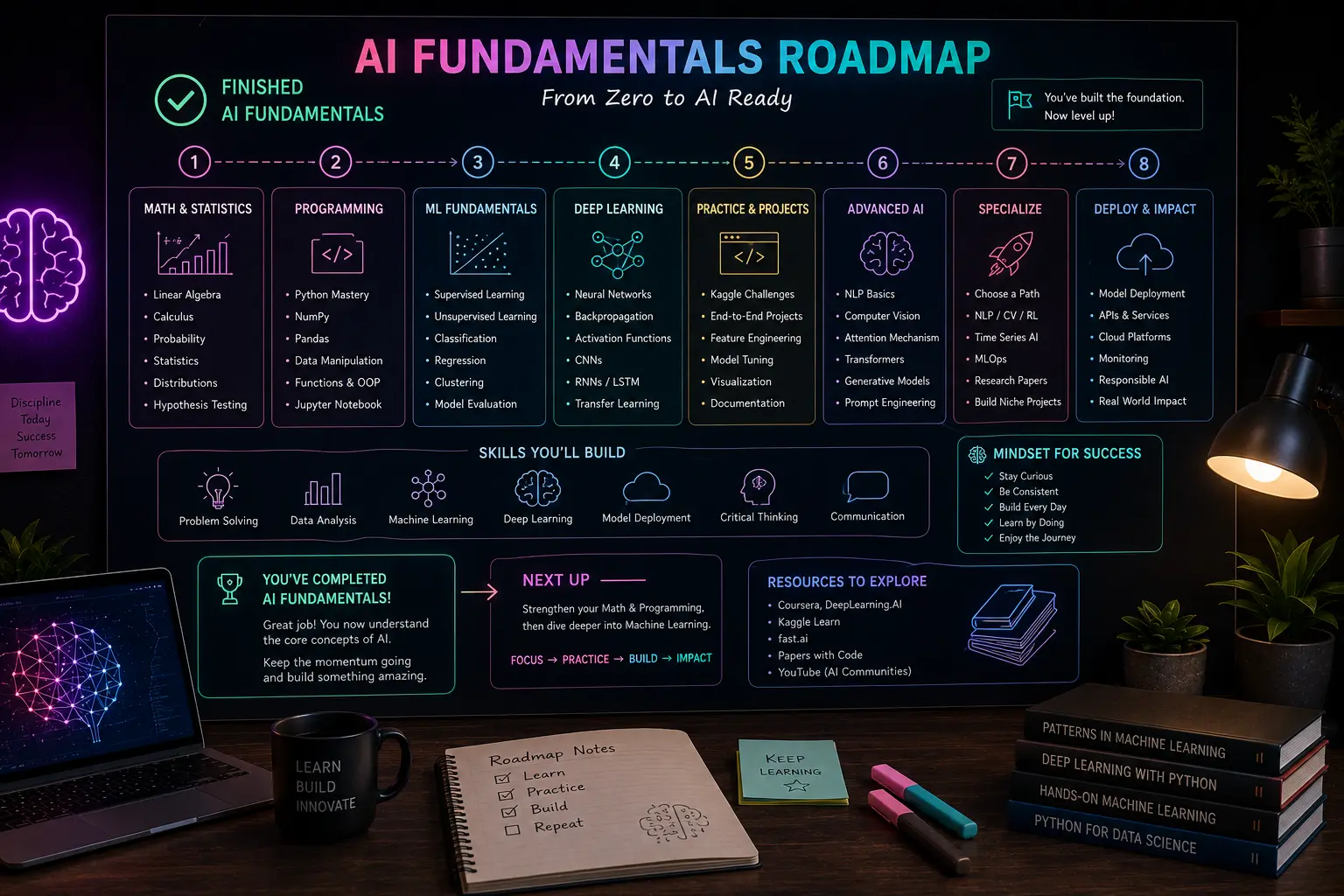
Finishing the free AI Fundamentals roadmap this builds on — working with pre-trained models, handling real messy data, prompt engineering for structured output, shipping one complete AI feature — puts you well ahead of the enormous number of people who can only describe AI concepts they've watched explainer videos about. But "AI" is not one job, and the paid courses that build on this foundation go in genuinely different directions.
This is the point where a strong foundational roadmap stops being enough on its own, and picking the wrong next specialization means months spent building skills that don't actually match the role you end up wanting. This guide breaks down the four natural next steps from AI Fundamentals, what each one actually involves, and how to figure out which one fits you.
Why "AI" Splits Into Four Directions
The AI Fundamentals roadmap teaches the shared base every AI specialization needs: solid Python, real data handling, working with pre-trained models and APIs, and prompt engineering fundamentals. What it deliberately doesn't do is go deep into any single specialization's advanced, job-specific skills — that's not a gap in the roadmap, it's by design, since no foundational path should try to cover everything.
Those specializations, and where they pick up from the foundation:
- AI Agent Engineering — building autonomous or semi-autonomous systems where an AI model decides what actions to take, not just answers questions
- LLM Infrastructure & MLOps — the operational side of running AI systems reliably in production: deployment, monitoring, and scaling models
- AI & LLM Security — securing AI systems against prompt injection, data leakage, and adversarial misuse, a genuinely new and fast-growing security specialization
- Applied RAG & Enterprise Search — building retrieval-augmented generation systems that let organizations search and reason over their own large, often messy internal knowledge bases
Each is a real, hireable specialization with meaningfully different daily work. None is objectively "the best AI job" — they suit different interests and strengths.
AI Agent Engineering
What it actually is: building systems where an AI model doesn't just respond to a single prompt, but takes a sequence of actions — calling tools, making decisions, adjusting based on results — toward a goal with limited direct human guidance at each step.
Who this suits: people who enjoyed the more complex, multi-step problem-solving parts of AI Fundamentals, and who find the idea of building systems that operate somewhat independently genuinely exciting rather than unsettling.
What it adds beyond the free roadmap: designing agent architectures and decision loops, tool-calling and function-calling patterns, handling the much harder reliability problems that come with multi-step autonomous behavior, and building in safety guardrails so an agent doesn't take unintended or harmful actions.
Typical next-role fit: AI Agent Engineer, Applied AI Engineer, or an AI-focused role at a company building autonomous or semi-autonomous product features. If building applied AI products sounds appealing, Generative AI Developer, one of the four directions out of AI Fundamentals, is the closest adjacent path worth comparing against this one.
LLM Infrastructure & MLOps
What it actually is: the operational backbone of AI systems — deploying models reliably, monitoring their performance and cost in production, managing versioning and rollbacks, and scaling infrastructure to handle real usage. This is AI work that looks a lot like DevOps, applied specifically to models.
Who this suits: people who enjoyed the "make it actually work reliably" side of things more than the model-behavior side — engineers who like infrastructure, monitoring, and systems thinking applied to a newer, AI-specific domain.
What it adds beyond the free roadmap: model serving and deployment patterns, monitoring model performance and drift over time, cost management for LLM API usage at scale, and the infrastructure discipline to keep AI-powered features reliable under real production load.
Typical next-role fit: MLOps Engineer, AI Infrastructure Engineer, or Platform Engineer at a company with AI features running in production.
AI & LLM Security
What it actually is: a genuinely new security specialization, focused on how AI systems get attacked and misused in ways traditional application security doesn't cover — prompt injection, jailbreaking, training data leakage, and adversarial inputs designed to manipulate model behavior.
Who this suits: people with a security mindset who find the AI angle genuinely interesting — this specialization rewards the same kind of "how would I break this" thinking as traditional security work, applied to a newer, less mature threat landscape.
What it adds beyond the free roadmap: understanding AI-specific vulnerability classes, building defenses against prompt injection and jailbreaking attempts, securing systems that handle sensitive data through an LLM, and staying current in a threat landscape that's still actively evolving.
Typical next-role fit: AI Security Engineer, Application Security Engineer with an AI specialization, or a security role at a company shipping AI-powered products.
Applied RAG & Enterprise Search
What it actually is: going deep specifically on retrieval-augmented generation — building systems that let an organization search, reason over, and get accurate answers from its own large, often messy internal documents and data, rather than only the model's general training knowledge.
Who this suits: people who enjoyed the data-handling and retrieval side of AI Fundamentals, and who like the idea of solving a very concrete, high-value business problem: making an organization's own knowledge actually searchable and useful.
What it adds beyond the free roadmap: advanced retrieval strategies and chunking techniques beyond the basics, handling very large and messy real-world document sets, evaluating and improving retrieval quality systematically, and integrating RAG systems into real enterprise search and knowledge tools.
Typical next-role fit: AI Engineer specializing in RAG/search, Applied AI Engineer, or a role at a company building internal knowledge tools or enterprise search products.
Side-by-Side: Which Path Fits You
| AI Agent Engineering | LLM Infrastructure & MLOps | AI & LLM Security | Applied RAG & Enterprise Search | |
|---|---|---|---|---|
| Day-to-day focus | Building autonomous systems | Deploying and scaling AI reliably | Defending AI systems from attack | Retrieval and enterprise search |
| Best fits | Multi-step problem solvers | Infrastructure and ops-minded | Security-minded, adversarial thinkers | Data and retrieval-focused |
| Closest adjacent field | Software engineering | DevOps / MLOps | Application security | Search engineering / data engineering |
| Field maturity | Newer, rapidly evolving | Maturing quickly | Very new, high demand | Maturing, strong enterprise demand |
| Market demand trend | Fast-growing | Strong and growing | Fast-growing, still niche | Strong, especially enterprise-side |
How to Actually Decide
If you're still unsure after reading the above, revisit your AI Fundamentals project and notice honestly which part you enjoyed most — not which part you were best at, which part actually held your attention.
- Enjoyed designing the multi-step logic and decision-making in your project → AI Agent Engineering
- Enjoyed the deployment, monitoring, and "keep it running reliably" parts → LLM Infrastructure & MLOps
- Found yourself thinking about how someone could misuse or break what you built → AI & LLM Security
- Enjoyed the data handling and retrieval quality parts more than the model behavior itself → Applied RAG & Enterprise Search
There's no wrong answer, and it's genuinely fine to still be deciding — but choosing based on real enjoyment of specific work, rather than which specialization sounds most impressive in a job title, tends to produce both better outcomes and stronger interviews.
Frequently Asked Questions
Do I need to fully master AI Fundamentals before starting one of these paid specializations?
Yes, in substance. Each paid course assumes real, working comfort with the foundational roadmap's core skills — Python fluency, data handling, working with pre-trained models and APIs, prompt engineering — and builds specialized knowledge directly on top. Starting a specialization without that foundation solid tends to produce confusion about material the course assumes you already have.
Which of these four has the strongest job market right now?
AI & LLM Security and AI Agent Engineering are both fast-growing with relatively less competition, since they're newer specializations that most self-taught learners haven't yet built real skills in. LLM Infrastructure & MLOps has strong, steady demand as more companies move AI features into real production. Applied RAG & Enterprise Search has particularly strong demand from established enterprises trying to make their existing internal data usable. Market conditions shift, so this is a general pattern rather than a guarantee.
Can I combine two of these specializations, like AI Security and MLOps?
Yes, and there's genuine overlap between some of these paths — securing AI infrastructure, for instance, benefits from understanding both AI security and MLOps concepts. But developing real depth in one first tends to produce a stronger, faster-moving career than trying to build breadth across all four from the start.
What if I finish AI Fundamentals and don't feel ready to specialize yet?
That's a reasonable position. Building one or two more complete AI Fundamentals-level projects — ideally ones that push you slightly further than your first one did — is a solid way to build additional confidence and a stronger portfolio before committing to a paid specialization.
Is AI & LLM Security a real, viable career path, or is it too early and niche?
It's genuinely early, but that's part of why it's a strong opportunity rather than a risk — being among the first wave of practitioners with real skill in an emerging, high-demand area, rather than one of many competing for a mature field's positions, is a real strategic advantage for someone building a career now.
See how Ciphemic's foundation compares to other platforms if you're also weighing where to build the AI Fundamentals base itself.
Choose Your Path
All four specializations build directly on what you learned in AI Fundamentals — none of them make that foundation obsolete. Explore the paid courses in the AI & Agents category to see the detailed curriculum for AI Agent Engineering, LLM Infrastructure & MLOps, AI & LLM Security, and Applied RAG & Enterprise Search, and find the one that matches where you actually want your career to go next.
Building along with this?
Join the Ciphemic Academia Discord — share what you're working on, get unstuck, and see what others are building.