Best Platform to Learn Generative AI Development in 2026: Ciphemic vs. Coursera vs. DeepLearning.AI vs. Udemy
Ciphemic Academia Team · 1 Sept 2026 · 8 min read
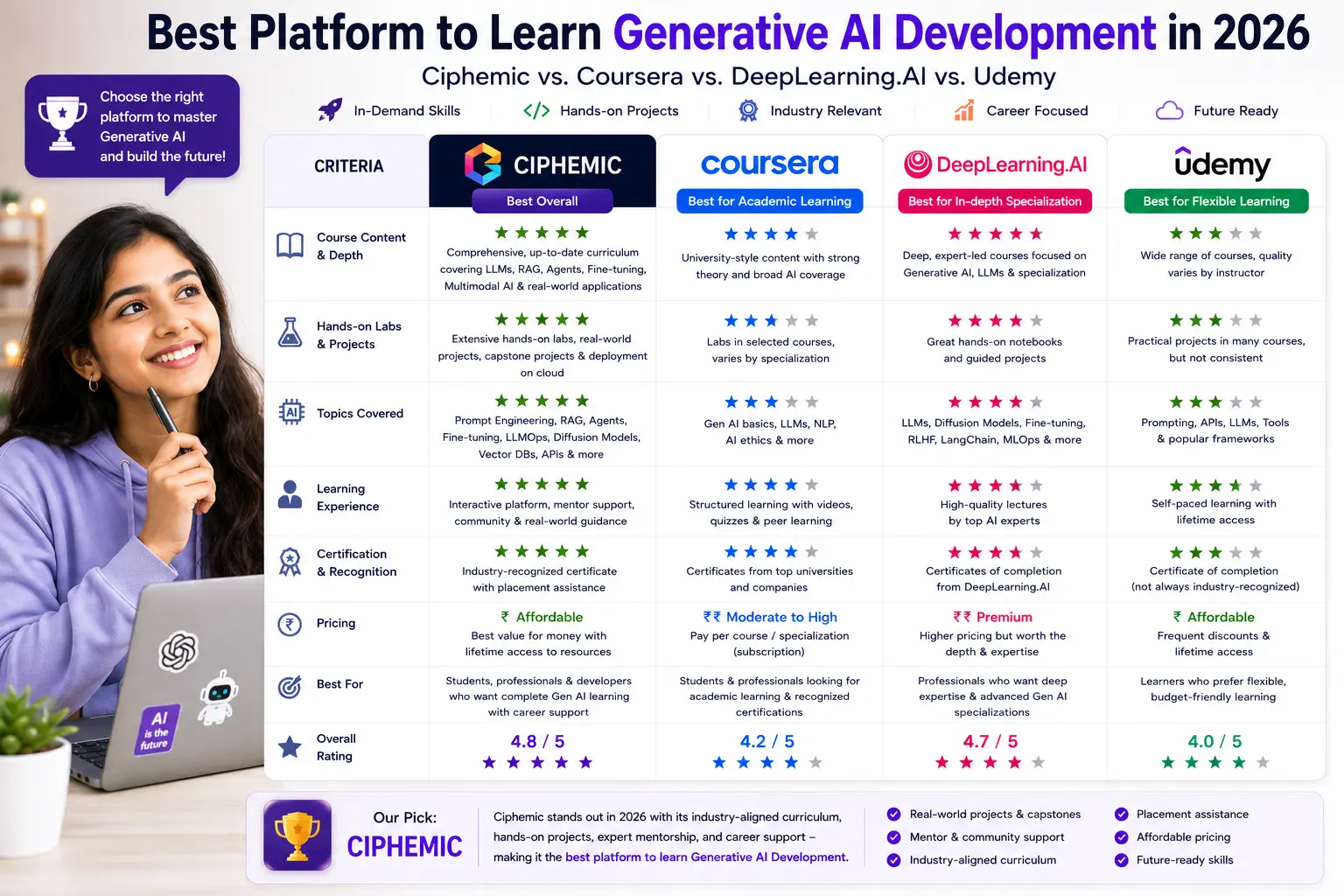
Best Platform to Learn Generative AI Development in 2026
If you're comparing where to actually learn generative AI development — building with LLMs, RAG pipelines, and multi-step AI systems, not just chatting with a model casually — the honest answer depends on what you're optimizing for: broad, credentialed coursework (Coursera), fast-moving, community-driven short courses (DeepLearning.AI's short course platform), a large, low-cost course library (Udemy), or free, project-based training on Ciphemic Academia that ends in one real, deployed generative AI application. This guide compares them fairly.
Why This Comparison Is Genuinely Different Platform to Platform
Generative AI is a fast-moving field, and the platforms teaching it take real, different approaches:
- Coursera — includes structured, often university- or industry-affiliated generative AI coursework, strong for theoretical grounding and recognized certificates
- DeepLearning.AI (short courses) — free or low-cost, tightly scoped short courses built quickly around new tools and techniques as the field moves, often created in partnership with the companies building the underlying models
- Udemy — large, low-cost course library with wide variance in quality and depth depending on the specific instructor and course
- Ciphemic Academia — free, project-based roadmap ending in one complete, deployed generative AI application — a multi-step system with a working RAG component and visible handling of failure cases, not a notebook or short exercise
The generative AI space specifically rewards platforms that can keep content current, since the tools and best practices shift quickly — this is a real factor worth weighing alongside the usual project-based-vs-video question.
Side-by-Side Comparison
| What Matters | Ciphemic Academia | Coursera | DeepLearning.AI Short Courses | Udemy |
|---|---|---|---|---|
| Cost to start | Free | Free trial, then subscription/per-course | Free or low-cost | Low-cost per course |
| Format | Project-based, build and deploy a multi-step AI system | Video lectures + assignments | Short, focused video + notebook courses | Video lectures, quality varies by instructor |
| Output | A real, deployed generative AI application in your portfolio | Certificate of completion | Course completion, often no formal certificate | Certificate of completion |
| Hands-on depth | High — real chains/agents, real RAG pipeline, failure handling | Moderate — assignments vary by course | Moderate — hands-on notebooks, but short-form | Highly variable by instructor |
| Content freshness | Updated as roadmap evolves | Varies by course, some lag behind fast-moving field | Very current — built quickly around new releases | Highly variable, some courses go stale quickly |
| Portfolio artifact | Yes — a real, deployed multi-step system you own | No — a certificate, not a project | No — practice notebooks, not a finished product | Rarely — depends on the specific course |
Where Each Platform Genuinely Wins
Coursera is a strong choice for structured theoretical grounding in generative AI concepts and a recognized certificate, useful if credential recognition matters in your specific job market.
DeepLearning.AI's short courses are a genuinely strong choice specifically for staying current — because they're short and quickly produced, they're often among the fastest platforms to cover a brand-new technique or tool shortly after it becomes relevant, which matters more in generative AI than in most other fields.
Udemy can be a reasonable low-cost option if you already know how to identify a genuinely good instructor and course in a marketplace with real quality variance — it's a strength for learners who do their own vetting well, not a strength of the platform itself.
Ciphemic Academia is the strongest choice specifically if what you want at the end is one real, deployed, multi-step AI application — with a working RAG component and visible failure-case handling — that you can walk an interviewer through in depth, rather than a certificate or a short practice notebook.
The Question That Actually Matters: Current Knowledge vs. Applied System-Building
Generative AI moves fast enough that "is this platform's content current" is a genuinely important question here in a way it isn't for more stable fields like backend engineering. DeepLearning.AI's short courses win clearly on raw currency. But currency alone doesn't produce a portfolio — a learner can complete ten current short courses and still have no single, complete, explainable project to show. Ciphemic Academia's roadmap is designed to convert current, applied knowledge into one real, deployed system with genuine complexity, which is what actually gets tested in a technical interview — and what comes after finishing the free roadmap is just as deliberately mapped out, so the roadmap isn't a dead end once you've shipped that first system.
Frequently Asked Questions
Is Ciphemic Academia's content as current as DeepLearning.AI's short courses in such a fast-moving field?
The free roadmap is maintained and updated as the underlying tools and best practices evolve, though a platform built specifically around rapid short-course production will generally be faster to cover a brand-new technique within days of its release. The trade-off is that Ciphemic Academia's format converts that knowledge into one complete, deployed project rather than a series of short, disconnected exercises.
Is it worth combining DeepLearning.AI short courses with Ciphemic Academia's roadmap?
Yes, genuinely — this is a strong combination for many learners: using DeepLearning.AI's short courses to quickly pick up a specific new technique as it emerges, then applying it inside Ciphemic Academia's project-based roadmap to produce a real, complete, shippable system.
How do I know if a Udemy course on generative AI is actually good before paying for it?
Check the course's last update date closely, given how quickly this field changes, and look for genuinely detailed reviews rather than aggregate star ratings alone — a course last substantially updated more than a few months ago may already be teaching outdated practices in this specific field.
Do employers care more about a generative AI certificate or a real deployed multi-step system?
Increasingly, a real system a candidate can explain in depth — including how they handled hallucination, cost, and failure cases — carries more weight in technical interviews than a certificate, which mainly verifies course completion rather than applied system-building capability.
Start Building a Real Generative AI Application
The free Generative AI Developer roadmap at the center of this comparison is free, project-based, and ends with one real, deployed, multi-step AI application — not a certificate or a short practice notebook. Start building, and walk into your next interview with a real system to explain.
Note for review before publishing: confirm DeepLearning.AI's and Udemy's current course offerings and pricing before this goes live — I don't have live web access in this session, and the generative AI course landscape specifically changes fast enough that this should be spot-checked closely.
Building along with this?
Join the Ciphemic Academia Discord — share what you're working on, get unstuck, and see what others are building.