
Finished Penetration Testing & Threat Modeling? Here's What's Next (2026)
Ciphemic Academia Team · 24 Aug 2026 · 6 min read
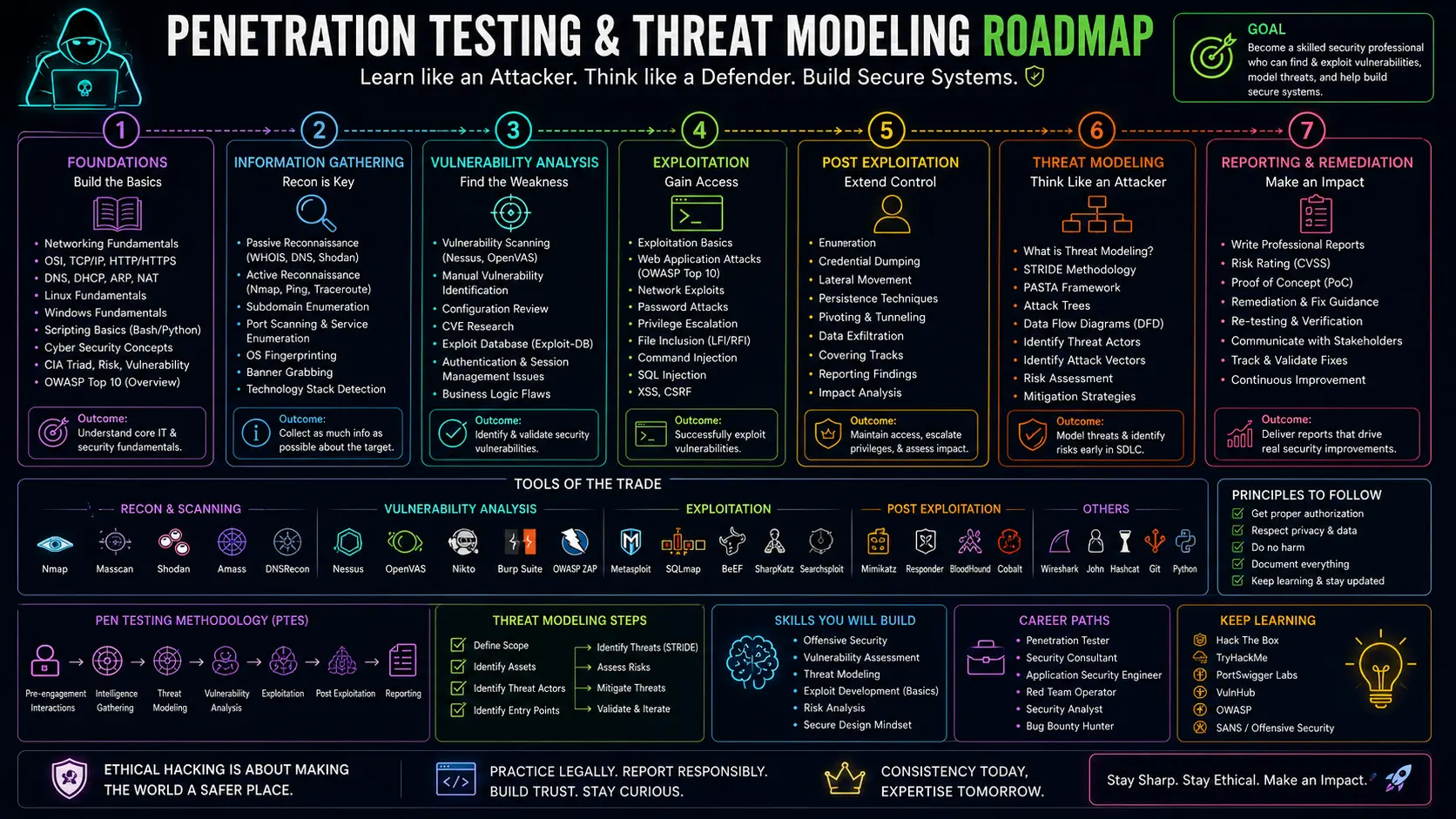
You Finished Penetration Testing and Threat Modeling. Now What?
Finishing the Penetration Testing and Threat Modeling roadmaps — thinking like an attacker, documenting findings like a professional, finding weak points before someone else does — puts you well ahead of people who only know security concepts in the abstract. Together they cover where Penetration Testing and Threat Modeling fit among all five security roadmaps. From here, one paid course goes considerably deeper and adds real, respected credentialing: the Offensive Security (OSCP Track).
Why This Is a Direct, Natural Next Step
Both free roadmaps build the mindset and foundational skill of offensive security. The OSCP Track takes that foundation and builds it into a rigorous, exam-tested, professionally respected credential — one of the clearest free-to-paid upgrade paths in the entire catalog.
Offensive Security (OSCP Track)
What it is: structured preparation for the OSCP (Offensive Security Certified Professional) certification — a hands-on, timed practical exam that requires actually compromising target systems under exam conditions, not answering multiple-choice questions about security concepts. Who this suits: people who genuinely enjoyed the hands-on, exploratory parts of Penetration Testing and Threat Modeling — the process of methodically finding and documenting a weakness, not just reading about vulnerability classes. What it adds: deep, structured exploit development and methodology practice, exam-specific preparation for the OSCP's demanding practical format, and the professional credibility the certification carries specifically because it's difficult and hands-on. Typical next-role fit: Penetration Tester, Offensive Security Engineer, Red Team Engineer — roles where the OSCP credential is frequently listed as preferred or required.
What Makes This Credential Different
A large part of the security field is saturated with credentials that test knowledge through multiple-choice exams. The OSCP's reputation comes specifically from being the opposite — a genuinely difficult, hands-on practical exam where you have to actually compromise systems within a fixed time window. That's exactly why employers weight it heavily: it's hard to fake, and it directly demonstrates the applied skill the free roadmaps started building.
Frequently Asked Questions
How difficult is the OSCP exam really? It has a well-earned reputation for being genuinely demanding — a timed, hands-on practical exam requiring real exploitation skill, not memorized knowledge. It typically requires serious, sustained preparation, which is exactly what this paid course is structured around. Do I need both Penetration Testing and Threat Modeling roadmaps completed first, or just one? Both provide genuinely complementary preparation — Penetration Testing builds the hands-on exploitation mindset, while Threat Modeling builds the systematic "where are the weak points" thinking that informs a good penetration test. Completing both gives a stronger foundation than either alone. Is the OSCP worth pursuing if I want to work in defensive security instead of offensive roles? It's more directly valuable for offensive/red-team roles, but the attacker's-eye thinking it builds has real value for defensive security work too — many strong defensive security engineers have offensive security backgrounds specifically because it's easier to defend against attacks you understand firsthand. If pipeline and infrastructure security is more your interest, the DevSecOps bridge, for readers who want pipeline security too covers that direction.
Go Deeper
The Offensive Security (OSCP Track) builds directly on both free roadmaps' foundation. Explore the course in the Security category to see the full curriculum and exam preparation structure.
Building along with this?
Join the Ciphemic Academia Discord — share what you're working on, get unstuck, and see what others are building.