Finished the Cloud Engineer Roadmap? Here's What to Learn Next (2026)
Ciphemic Academia Team · 24 Aug 2026 · 9 min read
You Finished the Cloud Engineer Roadmap. Now What?
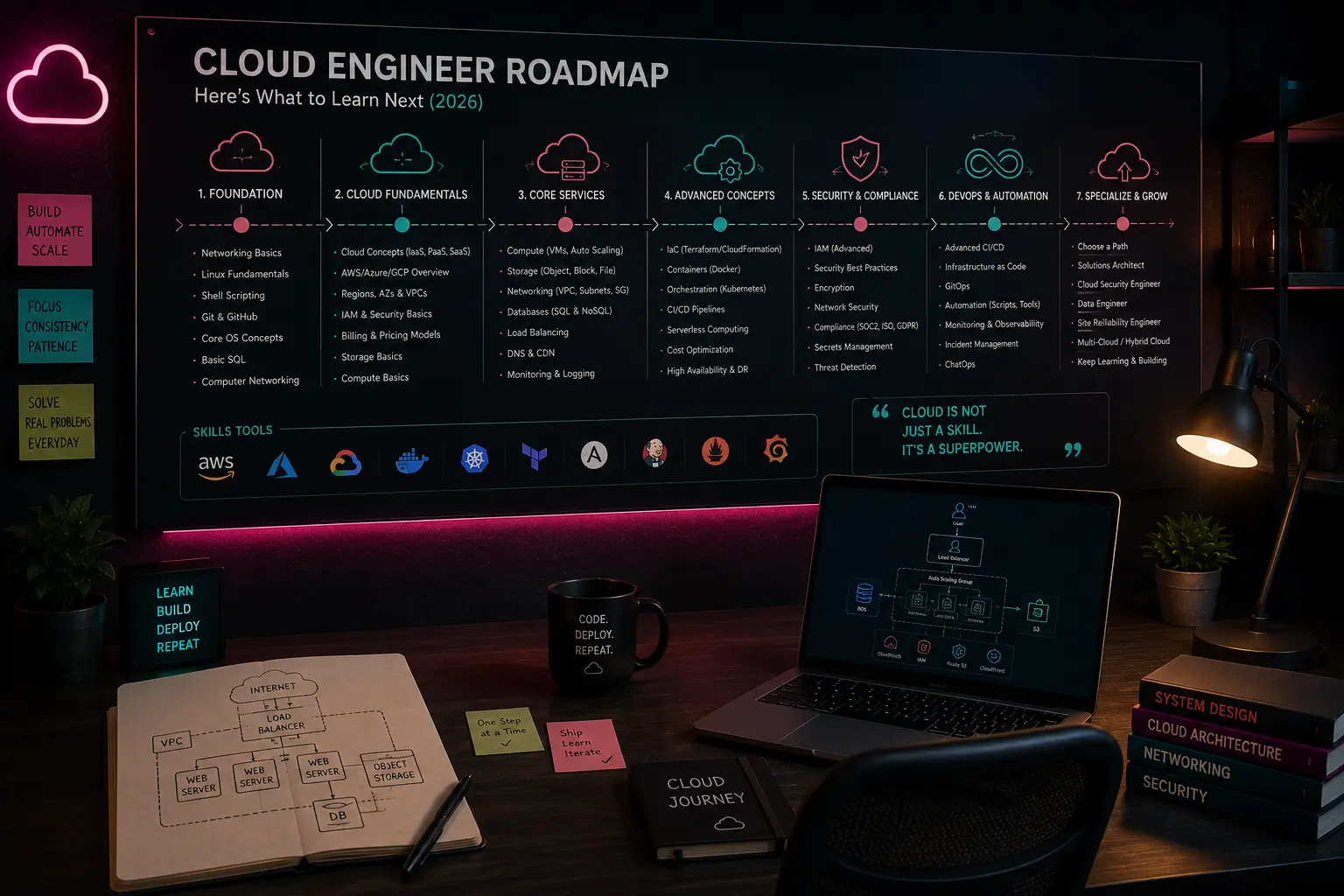
Finishing the free Cloud Engineer roadmap this builds on — provisioning real infrastructure with Terraform, containerizing and deploying an application, wiring up a working CI/CD pipeline — puts you meaningfully ahead of most self-taught candidates. But "cloud engineer" isn't one job. It's a starting point that branches into several genuinely different specializations, each with different daily work, different interview expectations, and different pay bands.
This is the question that trips people up after finishing a strong foundational roadmap: not "am I ready to specialize," but "which specialization actually fits what I want to do." Picking the wrong one wastes months. This guide breaks down the four natural next steps from the Cloud Engineer roadmap, what each one actually involves day to day, and how to figure out which fits you.
Why "Cloud Engineer" Splits Into Four Directions
The Cloud Engineer roadmap teaches the shared foundation every cloud specialization needs: infrastructure-as-code, containers, one cloud platform in depth, and CI/CD. What it deliberately doesn't do — because no foundational roadmap should try to do everything — is go deep into any single specialization's advanced, job-specific skills.
Those specializations, and where they pick up from the foundation:
- Multi-Cloud Solutions Architect — designing systems across multiple cloud providers, not just deploying within one
- Platform Engineering — building the internal tools and platforms that let other engineers deploy and operate their own services safely
- SRE at Scale — keeping systems reliable and fast under real production load and real incidents
- FinOps & Cloud Cost Engineering — a newer, increasingly in-demand specialization focused specifically on cloud cost visibility and optimization
Each is a legitimate, hireable specialization. None of them is "better" than the others in the abstract — they suit genuinely different interests and working styles.
Multi-Cloud Solutions Architect
What it actually is: designing infrastructure and application architecture that spans multiple cloud providers — AWS, Azure, GCP — rather than going deep on just one. This role sits closer to system design and architecture decisions than day-to-day implementation.
Who this suits: people who enjoyed the "why" behind the Cloud Engineer roadmap's infrastructure decisions more than the hands-on Terraform work itself — architects-in-the-making who think in trade-offs and system diagrams.
What it adds beyond the free roadmap: deep comparative knowledge of how AWS, Azure, and GCP each handle the same underlying problems differently, multi-cloud networking and identity federation, and the architectural judgment to know when multi-cloud is actually the right call versus unnecessary complexity.
Typical next-role fit: Solutions Architect, Cloud Architect, or a senior cloud engineering role at a company with genuine multi-cloud infrastructure.
Platform Engineering
What it actually is: building internal developer platforms — the tooling, self-service systems, and golden paths that let application engineers deploy and operate their own services without needing deep infrastructure expertise themselves. Platform engineers build the tools other engineers use.
Who this suits: people who enjoyed the CI/CD and infrastructure-as-code parts of the Cloud Engineer roadmap the most, and who like the idea of building tools and systems for other engineers rather than end users.
What it adds beyond the free roadmap: designing self-service infrastructure workflows, building internal tooling and abstractions on top of raw cloud primitives, and the product-thinking side of treating internal engineering teams as your actual "customers."
Typical next-role fit: Platform Engineer, Developer Experience Engineer, or Infrastructure Engineer at a company investing in internal tooling.
SRE at Scale
What it actually is: Site Reliability Engineering — keeping production systems reliable, fast, and observable, and being the person who gets paged when something breaks at 3 AM. This is the most operationally intense of the four paths.
Who this suits: people who like debugging under pressure, care deeply about system reliability and observability, and don't mind being on an on-call rotation as a real part of the job.
What it adds beyond the free roadmap: deep incident response practice, advanced observability and monitoring beyond basics, capacity planning, and the specific discipline of writing and living by SLOs (service-level objectives) — a core SRE practice the foundational roadmap doesn't cover.
Typical next-role fit: Site Reliability Engineer, Production Engineer, or Infrastructure Engineer at a company with serious uptime requirements.
FinOps & Cloud Cost Engineering
What it actually is: a genuinely newer specialization, born from the fact that cloud costs have become a major, often poorly understood line item for most companies running real infrastructure. FinOps engineers make cloud spend visible, explainable, and optimized — without breaking reliability to save money.
Who this suits: people who like the analytical, almost detective-work side of infrastructure — digging into why a bill spiked, figuring out which team's misconfigured resource is quietly burning budget, and building cost accountability into how a company operates.
What it adds beyond the free roadmap: cost allocation and tagging strategy, reading and acting on detailed billing data, rightsizing resources without degrading performance, and communicating cost trade-offs to both engineers and finance stakeholders — a genuinely cross-functional skill.
Typical next-role fit: Cloud Cost Engineer, FinOps Analyst/Engineer, or a cloud engineering role with cost ownership as part of the mandate.
Side-by-Side: Which Path Fits You
| Multi-Cloud Solutions Architect | Platform Engineering | SRE at Scale | FinOps & Cloud Cost Engineering | |
|---|---|---|---|---|
| Day-to-day focus | Architecture and system design | Building internal tools | Reliability and incident response | Cost visibility and optimization |
| Best fits | Big-picture thinkers | Tool-builders | Debuggers who like pressure | Analytical, detail-oriented |
| On-call expectation | Low | Low–moderate | High | Low |
| Cross-functional work | Moderate | Moderate | Low–moderate | High (works closely with finance) |
| Market demand trend | Steady | Growing | Steady, consistently strong | Fast-growing, newer field |
How to Actually Decide
If you're genuinely unsure after reading the above, a practical way to test-drive the decision: revisit your Cloud Engineer roadmap project and notice which part you enjoyed most, honestly, not which part you were best at.
- Enjoyed reasoning about why one architecture beats another → Multi-Cloud Solutions Architect
- Enjoyed building the CI/CD pipeline and thinking about making it reusable for others → Platform Engineering
- Enjoyed the debugging moments when something broke and you had to figure out why, fast → SRE at Scale
- Enjoyed thinking about resource efficiency and noticed yourself questioning "do we actually need this much infrastructure" → FinOps & Cloud Cost Engineering
There's no wrong answer here, and it's genuinely fine to not be certain yet — but picking based on real enjoyment of specific work, rather than which title sounds most impressive, tends to produce both better outcomes and better interviews, since genuine interest comes through clearly to anyone interviewing you.
Frequently Asked Questions
Do I need to fully master the free Cloud Engineer roadmap before starting a paid specialization course?
Yes, in substance if not in every last detail. Each paid course assumes real comfort with the foundational roadmap's core skills — Terraform, containers, one cloud platform, CI/CD — and builds specialized knowledge on top of that base. Starting a specialization without that foundation solid tends to produce confusion about material the course assumes you already have.
Can I take more than one of these paid courses eventually?
Yes, and it's common over the course of a career — many senior cloud engineers eventually develop real breadth across two or more of these areas. But specializing in one first, deeply, tends to produce a stronger and faster-moving career than trying to build all four simultaneously from the start.
Which of these four has the strongest job market right now?
SRE roles have been consistently strong and well-paid for years. FinOps is a newer, fast-growing specialization with less competition for the roles that do exist. Platform Engineering demand is growing quickly as more companies invest in internal developer experience. Multi-Cloud Solutions Architect roles tend to be more senior and require more overall experience to land. Market conditions shift, so this is a general pattern rather than a guarantee.
What if I finish the Cloud Engineer roadmap and don't feel ready to specialize yet?
That's a completely reasonable position. Building one or two more general infrastructure projects, or exploring an adjacent free roadmap like Kubernetes or Docker in more depth, is a fine way to build additional confidence before committing to a paid specialization course.
Is it a mistake to pick a specialization based on salary rather than genuine interest?
It's a common approach, but it carries real risk — these are meaningfully different day-to-day jobs, and a mismatch between the actual daily work and what you enjoy tends to show up as burnout or a stalled career within a couple of years, regardless of the starting salary. Genuine interest is a better long-term bet even when the immediate numbers look similar across paths.
See how Ciphemic's approach compares to other platforms if you're also weighing where to actually take one of these specialization courses.
Choose Your Path
All four specializations build directly on what you learned in the Cloud Engineer roadmap — none of them make that foundation obsolete. Explore the paid courses in the Cloud & Platform category to see the detailed curriculum for Multi-Cloud Solutions Architect, Platform Engineering, SRE at Scale, and FinOps & Cloud Cost Engineering, and find the one that matches where you actually want your career to go next.
Building along with this?
Join the Ciphemic Academia Discord — share what you're working on, get unstuck, and see what others are building.