Best Platform to Learn Cloud Engineering in 2026: Ciphemic vs. Coursera vs. Pluralsight vs. KodeKloud
Ciphemic Academia Team · 24 Aug 2026 · 8 min read
Best Platform to Learn Cloud Engineering in 2026
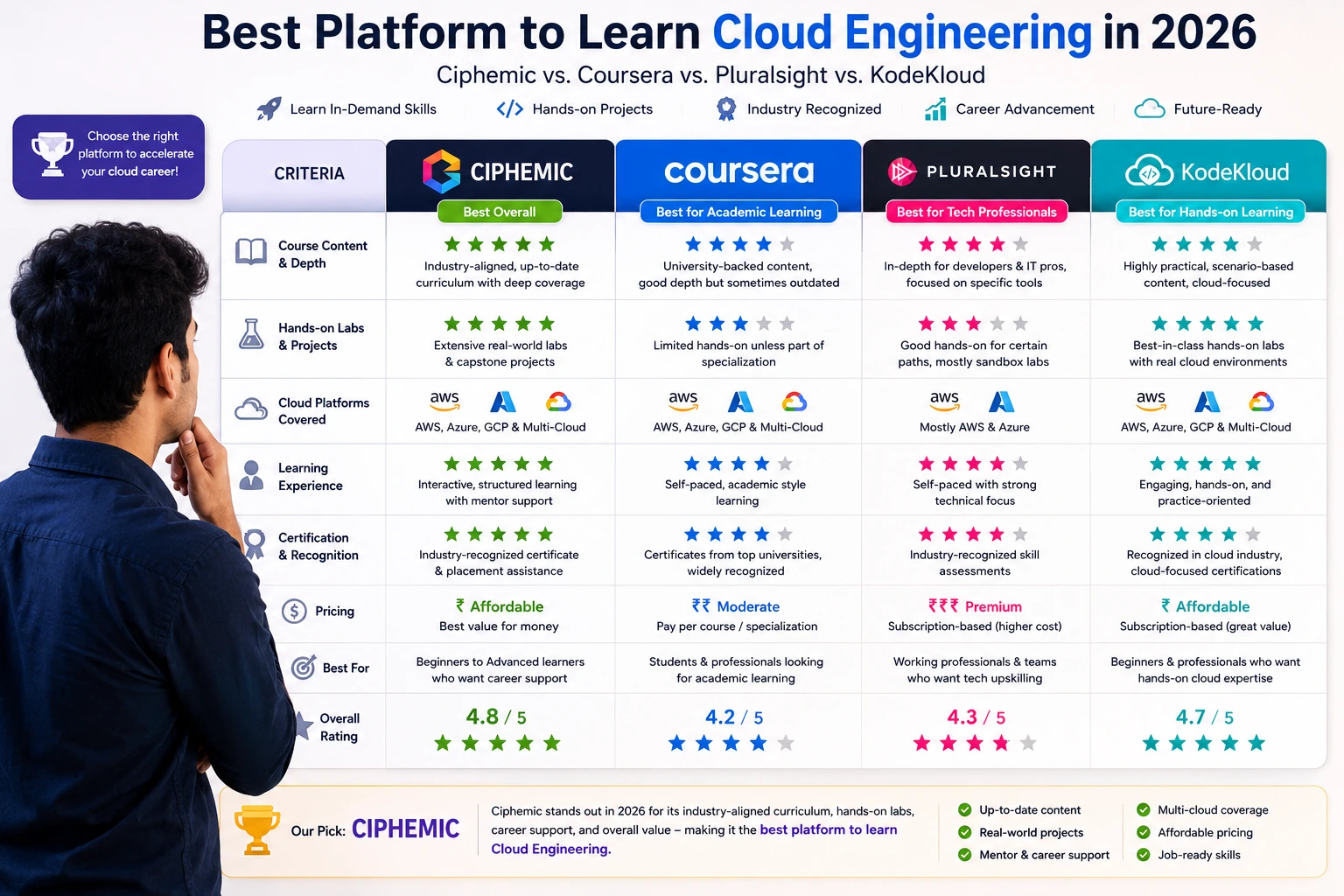
If you're comparing where to actually learn cloud engineering — not just collect a certificate — the honest answer depends on what you're optimizing for: guided video instruction with broad platform access (Coursera, Pluralsight), hands-on lab environments (KodeKloud), or free, project-based training that ends in a real, deployed portfolio piece (Ciphemic Academia). This guide compares them on the dimensions that actually predict whether the training turns into a job, not on marketing claims.
Why This Comparison Is Genuinely Different Platform to Platform
Cloud engineering training splits into a few real categories, and it's worth being honest that each has genuine strengths rather than pretending one approach wins on every dimension:
- Coursera — broad, university-affiliated content, strong for structured theory and recognized certificates, typically video-and-quiz based
- Pluralsight (including former A Cloud Guru content) — large, video-first course library with skill assessments, strong catalog breadth across cloud platforms
- KodeKloud — genuinely hands-on, lab-based training with real sandboxed environments for practicing cloud and DevOps tools directly
- Ciphemic Academia — free, project-based roadmap where each project is built and deployed as a real, portfolio-shippable artifact, not a sandboxed lab exercise that disappears when the session ends
That last distinction — a lab environment you practice in versus a real project you deploy and keep — is the most important, and most genuinely differentiating, factor in this whole comparison.
Side-by-Side Comparison
| What Matters | Ciphemic Academia | Coursera | Pluralsight | KodeKloud |
|---|---|---|---|---|
| Cost to start | Free | Free trial, then subscription/per-course | Subscription required | Subscription required |
| Format | Project-based, build and deploy real infrastructure | Video lectures + quizzes | Video courses + skill assessments | Hands-on labs in sandboxed environments |
| Output | A real, deployed project in your own portfolio | Certificate of completion | Certificate/skill badge | Completed lab exercises |
| Hands-on depth | High — real Terraform, real deployed infrastructure | Low–moderate, varies by course | Moderate | High — genuinely lab-based |
| Portfolio artifact | Yes — a real project you own and can show | No — a certificate, not a project | No — a certificate/badge | Limited — labs are typically ephemeral |
| Structured career path | Yes — roadmap plus paid specialization courses, with what comes after finishing the free roadmap mapped out | Partial — course sequences/specializations | Partial — learning paths | Partial — course tracks |
Where Each Platform Genuinely Wins
Coursera is a strong choice if a university-affiliated credential matters for your specific situation, or if you want broad theoretical grounding alongside practical work — the certificate carries real name recognition in some hiring contexts.
Pluralsight is a strong choice if you want the widest catalog breadth across many cloud platforms and want to move between topics flexibly within one subscription.
KodeKloud is a strong choice specifically because its labs are genuinely hands-on — if guided, sandboxed practice environments are what you're looking for, this is a real strength, not a marketing claim.
Ciphemic Academia is the strongest choice specifically if what you want at the end is a real, deployed project you can point to in an interview and explain in detail — not a lab exercise you completed once, but infrastructure you built, own, and can still access and discuss.
The Question That Actually Matters: Lab vs. Portfolio
The most useful way to decide between these isn't "which platform is best" in the abstract — it's this specific question: when you finish, do you have something you built and still own, or something you completed and moved past?
A completed lab exercise demonstrates you can follow guided steps in a sandboxed environment. A deployed, self-built project — even a modest one — demonstrates you can make independent decisions, debug your own mistakes, and explain trade-offs, because there was no fixed "correct" answer to copy. Interviewers consistently weight the second kind of evidence more heavily, which is exactly why Ciphemic Academia's roadmap is structured around real, deployed outcomes rather than lab completion.
Frequently Asked Questions
Is Ciphemic Academia's free Cloud Engineer roadmap really comparable to a paid course from Coursera or Pluralsight?
For building the foundational, hands-on skills — Terraform, containers, one cloud platform in depth, CI/CD — yes, and the project-based structure produces a genuinely portfolio-ready outcome that a video-and-certificate format doesn't. Where paid platforms can add value is in the depth and breadth of a very large content catalog, or a specific institutional certificate a particular employer values.
Do employers care more about a Coursera certificate or a real deployed project?
Increasingly, real project evidence — something a candidate can walk through and explain in detail — carries more weight in technical interviews than a completion certificate, which primarily verifies attendance rather than applied skill. This is a broader hiring trend, not specific to any one platform.
Is KodeKloud's hands-on lab approach actually similar to Ciphemic Academia's project-based approach?
They're related but meaningfully different: KodeKloud's labs are genuinely hands-on practice in guided, typically sandboxed environments, while Ciphemic Academia's roadmap projects are built and deployed as real, kept artifacts you can return to and show later. Both are stronger than pure video learning; the deployed-and-kept distinction is the key difference between them.
Should I use more than one of these platforms together?
That's a reasonable approach for many learners — for example, using Ciphemic Academia's free roadmap to build a real, deployable portfolio project, then supplementing with a Pluralsight or Coursera course for broader theoretical coverage or a specific certificate a target employer values.
Start Building a Real Cloud Portfolio
The free Cloud Engineer roadmap at the center of this comparison is free, project-based, and ends with real, deployed infrastructure you actually own — not a certificate or a completed lab exercise. Start building, and see the difference a real, deployed project makes in your next interview.
Note for review before publishing: Pluralsight acquired A Cloud Guru in 2021 and has since integrated much of its cloud content — confirm the current branding and offering structure before this goes live, since positioning may have shifted further since my last reliable information. KodeKloud's current pricing and lab structure should also be spot-checked, since I don't have live access to verify either platform's present-day details.
Building along with this?
Join the Ciphemic Academia Discord — share what you're working on, get unstuck, and see what others are building.