Best Platform to Learn AI Fundamentals in 2026: Ciphemic vs. Coursera vs. DataCamp vs. Kaggle Learn
Ciphemic Academia Team · 24 Aug 2026 · 8 min read
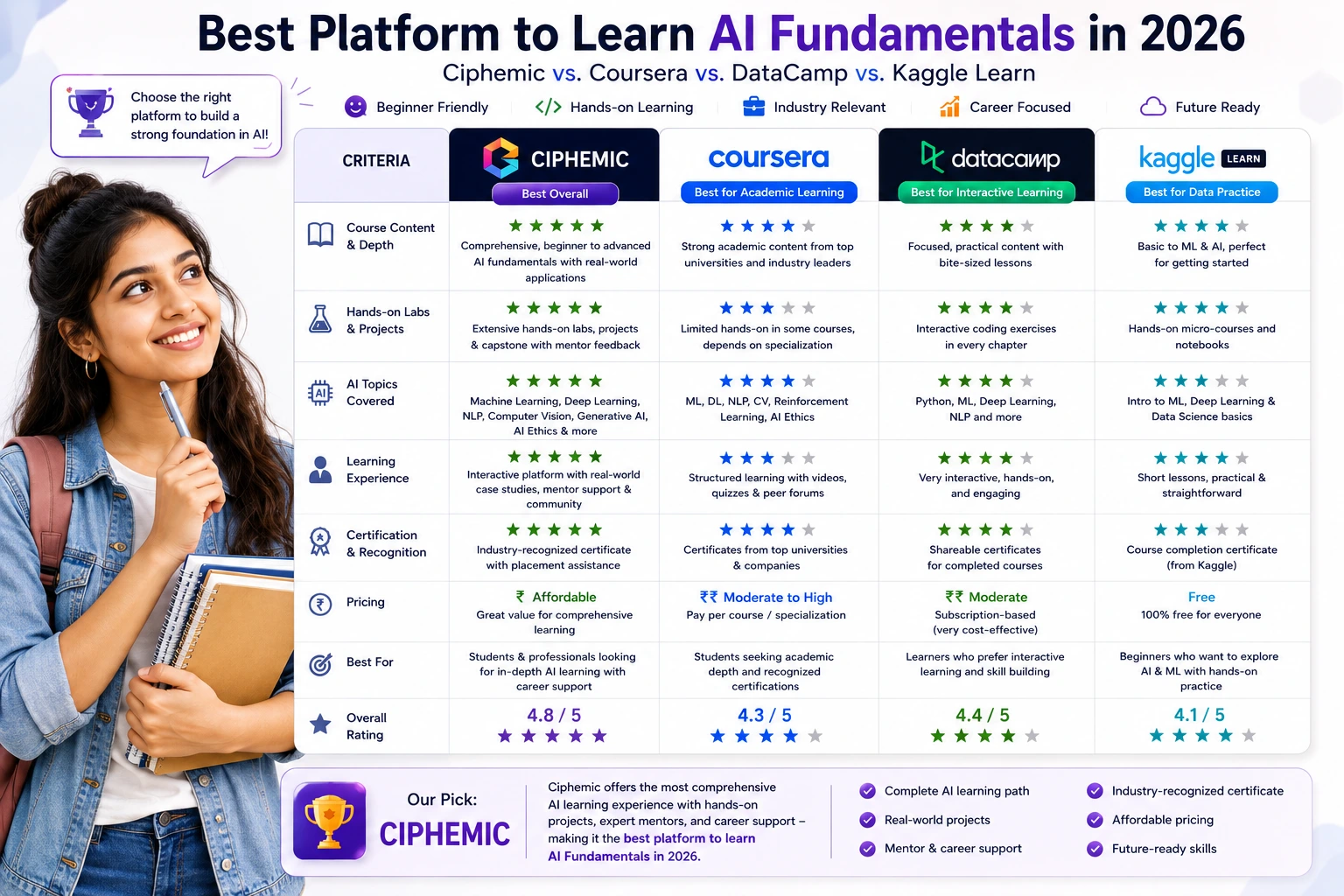
Best Platform to Learn AI Fundamentals in 2026
If you're comparing where to actually learn AI fundamentals — not just watch explainer videos about transformers — the honest answer depends on what you're optimizing for: structured, credentialed coursework (Coursera), interactive data-science-first learning (DataCamp), free bite-sized micro-courses (Kaggle Learn), or free, project-based training that ends in one real, deployed AI feature (Ciphemic Academia). This guide compares them on what actually predicts job-readiness, not marketing claims.
Why This Comparison Is Genuinely Different Platform to Platform
AI learning platforms split into real, distinct categories, each with genuine strengths worth being honest about:
- Coursera — includes well-known, university- and industry-affiliated AI coursework (including DeepLearning.AI's offerings), strong for structured theory and recognized certificates
- DataCamp — interactive, browser-based coding exercises with an emphasis on data science and applied AI/ML skills, strong for guided, incremental skill-building
- Kaggle Learn — free, short, focused micro-courses, often paired with Kaggle's competition and notebook ecosystem for practice
- Ciphemic Academia — free, project-based roadmap where the outcome is one real, deployed AI feature you built and can explain end to end, not a completed notebook or course module
The core distinction, same as with the cloud engineering comparison: does the training end in something you built, deployed, and own — or something you completed and moved past?
Side-by-Side Comparison
| What Matters | Ciphemic Academia | Coursera | DataCamp | Kaggle Learn |
|---|---|---|---|---|
| Cost to start | Free | Free trial, then subscription/per-course | Subscription required | Free |
| Format | Project-based, build and deploy one real AI feature | Video lectures + graded assignments | Interactive in-browser coding exercises | Short micro-courses + notebooks |
| Output | A real, deployed AI application in your portfolio | Certificate of completion | Completion badge/certificate | Completed micro-course, practice notebooks |
| Hands-on depth | High — real APIs, real messy data, a shipped feature | Moderate — assignments vary by course | Moderate-high — exercises are hands-on but scoped/guided | Moderate — notebooks are hands-on but short-form |
| Portfolio artifact | Yes — a real, deployed application you own | No — a certificate, not a project | Limited — exercises are typically not portfolio-ready as-is | Limited — practice notebooks, not a finished product |
| Structured career path | Yes — roadmap plus paid specialization courses, with what comes after finishing the free roadmap mapped out | Partial — specializations/course sequences | Partial — skill tracks | No — individual courses, not a full path |
Where Each Platform Genuinely Wins
Coursera is a strong choice for structured theoretical grounding and a recognized certificate, especially through well-known instructor-affiliated coursework — valuable if credential recognition matters in your specific job market.
DataCamp is a strong choice if you want tightly scoped, interactive, incremental skill-building — particularly strong for the data science and statistics side of AI work specifically.
Kaggle Learn is a strong choice for quickly building specific, narrow skills for free, and its tight integration with Kaggle's competitions and notebooks gives a natural next step for practicing what you learn against real datasets.
Ciphemic Academia is the strongest choice specifically if what you want at the end is one real, deployed AI application you can walk an interviewer through in detail — including the messy data you handled and the trade-offs you made — not a certificate or a short practice notebook.
The Question That Actually Matters: Notebook vs. Shipped Product
The most useful way to decide isn't "which platform is best" abstractly — it's this: when you finish, do you have a notebook that ran once, or an application someone else could actually use? A notebook proves you can follow a guided exercise. A deployed application — even a modest one — proves you can integrate a model into something real, handle failure cases, and explain the architecture, because there was no fixed correct answer to copy. This is exactly why Ciphemic Academia's AI Fundamentals roadmap is structured around one complete, shipped project rather than a series of short exercises.
Frequently Asked Questions
Is Ciphemic Academia's free AI Fundamentals roadmap really comparable to a paid Coursera or DataCamp course?
For building genuinely applied skill — working with real APIs, messy data, and shipping one complete AI feature — yes, and the project-based structure produces a portfolio-ready outcome those formats typically don't. Where paid platforms add real value is in very broad theoretical coverage or a specific, widely recognized certificate.
Is Kaggle Learn a good complement to Ciphemic Academia rather than a competitor?
Yes, genuinely — many learners use Kaggle Learn's short, free micro-courses to quickly pick up a specific narrow skill, then apply it inside a larger, real project like the one Ciphemic Academia's roadmap builds toward. The two work well together rather than as strict alternatives.
Do employers care more about an AI certificate or a real deployed project?
Increasingly, evidence of applied skill — a real project a candidate can explain in depth, including problems they hit and how they solved them — carries more weight in technical interviews than a certificate alone, which mainly verifies course completion rather than applied capability.
Should I combine Ciphemic Academia with DataCamp or Coursera?
That's a reasonable approach for many learners — using DataCamp or Coursera for deep, structured coverage of a specific sub-topic like statistics or a particular ML technique, then applying that knowledge inside Ciphemic Academia's project-based roadmap to produce a real, shippable outcome.
Start Building a Real AI Portfolio
The free AI Fundamentals roadmap at the center of this comparison is free, project-based, and ends with one real, deployed AI feature you built and can fully explain — not a certificate or a practice notebook. Start building, and walk into your next interview with something real to show.
Note for review before publishing: confirm DataCamp's and Kaggle Learn's current pricing, format, and positioning before this goes live — I don't have live web access in this session, so these characterizations are based on general, possibly outdated knowledge and should be spot-checked for accuracy.
Building along with this?
Join the Ciphemic Academia Discord — share what you're working on, get unstuck, and see what others are building.