Python vs. Go for Backend Services: 65% Lower Cloud Costs, One Rewrite
Ciphemic Academia Team · 5 Oct 2026 · 11 min read
Python vs. Go for Backend Services: 65% Lower Cloud Costs, One Rewrite
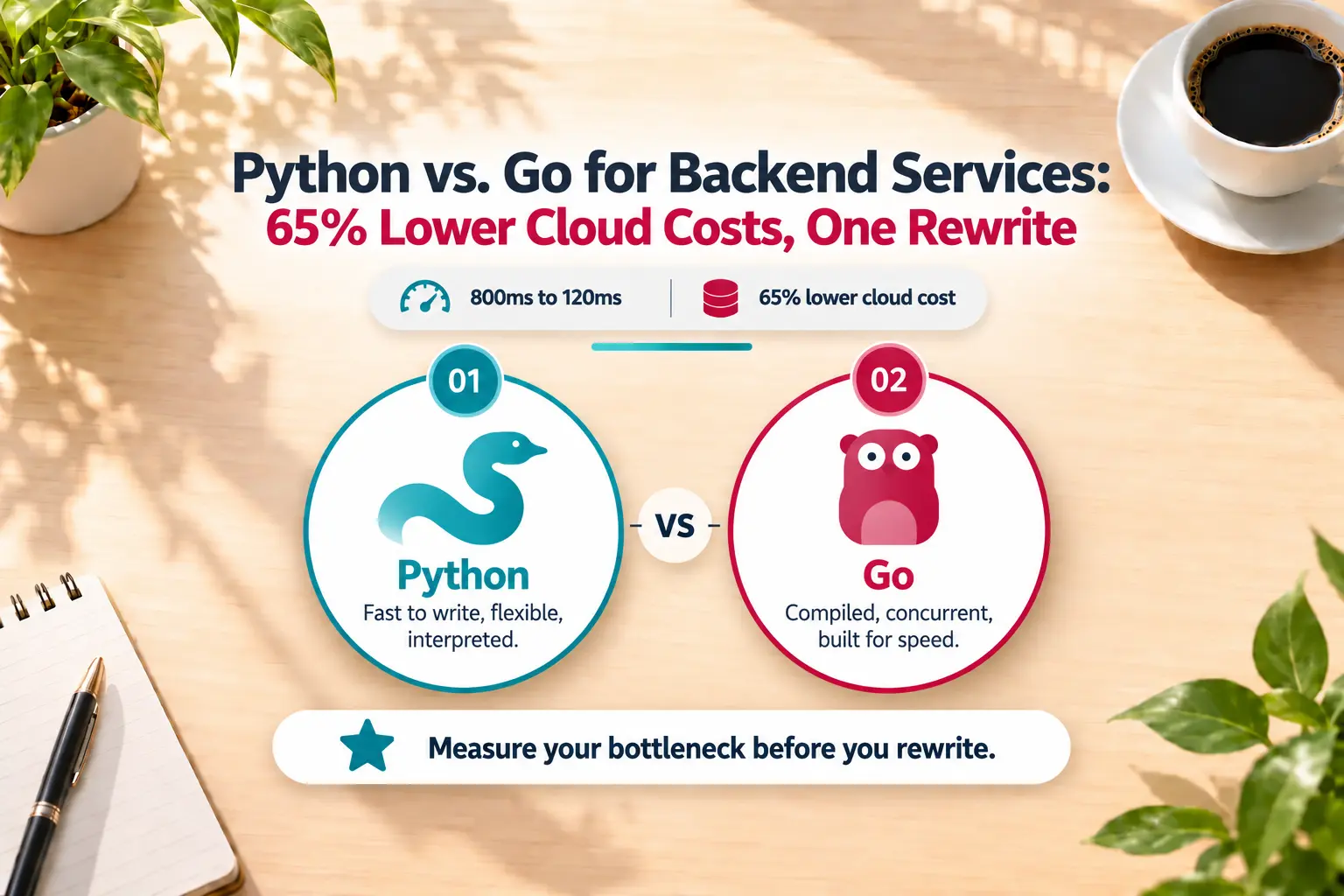
In late 2023, an engineering team at Vodafone rewrote a suite of Python AWS Lambda microservices in Go. They didn't touch the business logic, just the language. Functions that took 800 milliseconds in Python came back in 120 milliseconds in Go, and the migration cut their cloud costs by 65%. A few years earlier, Khan Academy ran a much bigger version of the same bet: a multi-year project to rewrite its entire Python 2 monolith as Go services, eventually shipping more than 500,000 lines of Go to production. One specific case they documented, a class of 1,000 students that took 28 seconds to load in Python, loaded in 4 seconds in Go.
Neither team rewrote their backend because Go is trendy. They rewrote because a specific, measured bottleneck, cost in Vodafone's case, raw load time in Khan Academy's, made the switch worth real engineering effort. This guide compares Python and Go honestly for backend work: what each language actually optimizes for, where these real numbers come from, and how to decide before you've built years of Python you'll later have to migrate off, or worse, rewritten in Go when you never needed to.
If backend fundamentals are still new ground, our Backend Engineer roadmap covers what this comparison builds on.
The Short Version
- Python is a dynamically typed, interpreted language with an enormous ecosystem, famous for fast development speed and readability, at a real runtime performance cost.
- Go is a statically typed, compiled language built by Google specifically for simple, fast, concurrent backend services, trading some of Python's expressiveness for speed and predictability.
If you want one default: start with Python if you're optimizing for development speed, a smaller team, or heavy use of Python-specific ecosystems (data science, ML). Reach for Go specifically once you have a measured performance or cost bottleneck, the way Vodafone and Khan Academy both did, not before.
What Both Are Actually Trying to Solve
Before the differences, the shared job, since this is what any backend language exists to do:
- Handling requests reliably: both need to receive a request, do some work, and return a response, correctly, under real load
- Managing concurrency: both need a story for handling many requests at once without one slow request blocking everything else
- Integrating with the rest of your stack: databases, queues, caches, third-party APIs, both need solid, well-supported ways to talk to all of it
- Staying maintainable as a team grows: code that's easy to read, test, and change safely matters regardless of which language you chose
The real difference is what each language assumes is more valuable: developer speed and flexibility, or raw execution speed and predictability, and that trade-off is exactly what shows up in Vodafone's and Khan Academy's numbers.
Python
What it actually is: a dynamically typed, interpreted language where you don't declare variable types, the interpreter figures them out at runtime, and you don't compile your code before running it. For backend work, frameworks like Django, Flask, and FastAPI handle the web-serving layer on top of the language itself.
A small example (a simple endpoint, FastAPI):
@app.get("/orders/{order_id}")
async def get_order(order_id: int):
    order = await db.fetch_order(order_id)
    return {"id": order.id, "total": order.total}
Where it shines:
- Fast development speed: Python's concise, readable syntax and lack of a compile step mean you can write and test code quickly, which is exactly why most teams, including Vodafone's original stack, start there
- Enormous ecosystem: mature libraries for nearly everything, especially data science, machine learning, and scripting, make Python a natural default when a backend touches those domains
- Gentle learning curve: Python is widely considered one of the easier languages to learn and read, which helps onboarding and lowers the bar for new contributors
- Great for prototyping and iteration: when a product's requirements are still shifting, Python's flexibility lets you change direction without fighting the language
Where it struggles:
- Real runtime performance ceiling: Python's interpreted execution and the Global Interpreter Lock (GIL) genuinely limit raw speed and true multi-threaded concurrency, which is precisely the bottleneck Vodafone's 800ms functions were hitting
- Higher resource cost at scale: slower execution translates directly into needing more compute to handle the same load, which is where Vodafone's 65% cost reduction came from
- Dynamic typing can hide bugs until runtime: without discipline (and tools like type hints and mypy), type-related bugs that a compiler would catch in Go can slip through to production
- Concurrency is less natural: Python's
asyncioand threading models work, but they're less of a first-class, built-in feature than Go's goroutines
Who this suits: teams prioritizing development speed and iteration, products with heavy data science or ML components, and most backends until a specific, measured bottleneck says otherwise.
Go
What it actually is: a statically typed, compiled language created at Google specifically to make writing simple, fast, highly concurrent network services easier. Code compiles to a single binary, concurrency is a built-in language feature (goroutines and channels), and the language deliberately has a small feature set to keep code consistent and readable across large teams.
A small example (the same endpoint, Go):
func getOrder(w http.ResponseWriter, r *http.Request) {
    id := chi.URLParam(r, "orderID")
    order, err := db.FetchOrder(id)
    if err != nil {
        http.Error(w, err.Error(), 500)
        return
    }
    json.NewEncoder(w).Encode(order)
}
Where it shines:
- Real performance gains: compiled, statically typed execution is exactly why Vodafone's functions dropped from 800ms to 120ms, and why Khan Academy's 28-second case became 4 seconds, both real, measured, production numbers
- Built-in concurrency: goroutines make writing concurrent code dramatically simpler than in most languages, which matters directly for backend services juggling many simultaneous requests
- Lower resource usage: faster execution and a smaller memory footprint translate into genuine infrastructure cost savings at scale, the direct driver of Vodafone's 65% figure
- Catches errors earlier: static typing and compilation surface a real class of bugs before code ever reaches production, something Khan Academy's engineers specifically noted as a benefit during their migration
Where it struggles:
- More verbose than Python: Khan Academy's own engineers, after porting 500,000 lines, noted plainly that Go is more verbose in general than Python, certain things that are concise in Python take more code in Go
- Smaller ecosystem for some domains: data science and ML tooling, in particular, remain far more mature in Python; Go is not generally the language teams reach for there
- Steeper initial learning curve for dynamic-language developers: engineers coming from Python need to adjust to explicit typing, error handling as return values instead of exceptions, and a more rigid structure
- Migration itself is real work: both Vodafone's and Khan Academy's rewrites were deliberate, resourced engineering projects, not quick swaps, Khan Academy's took roughly 20 months
Who this suits: backend services with a genuine, measured performance or cost bottleneck, systems with heavy concurrency needs, and teams building for scale where infrastructure cost is a real, ongoing line item.
Side-by-Side Comparison
| Python | Go | |
|---|---|---|
| Typing | Dynamic | Static |
| Execution | Interpreted | Compiled to a single binary |
| Concurrency model | asyncio/threading, limited by the GIL | Goroutines, built into the language |
| Measured real-world case | 800ms per function (Vodafone, before) | 120ms per function (Vodafone, after) |
| Development speed | Faster to write and iterate | More verbose, more upfront structure |
| Resource cost at scale | Higher | Lower, direct driver of Vodafone's 65% savings |
| Ecosystem strength | Data science, ML, scripting | Networked services, CLI tools, infrastructure |
| Error detection | Mostly at runtime | Many errors caught at compile time |
How This Fits a Career Path
- Backend Engineer (general): Python remains an extremely strong starting point and stays relevant for a huge share of real jobs, especially where ecosystem breadth matters more than raw throughput
- Platform, infrastructure, or high-scale backend engineer: Go is close to a standard expectation here, and understanding when and why teams like Vodafone and Khan Academy migrated is exactly the reasoning interviewers probe for
- Data-heavy or ML-adjacent backend roles: Python's ecosystem advantage is large enough here that it typically remains the default regardless of raw language performance
- System design interviews: be ready to justify a language choice the way Vodafone and Khan Academy did, a specific, measured problem, not a language preference stated as fact
How to Choose Without Overthinking It
- Start with Python unless you already know you need Go. Development speed and ecosystem breadth win for most new backend projects, especially early on when requirements are still shifting.
- Look for an actual, measured bottleneck before migrating. Vodafone didn't start with Go, they measured real cost and latency problems in Python first. Rewriting a working service because a language sounds faster, without your own numbers, is how teams waste real engineering time.
- Weigh your team's concurrency needs honestly. If your service is CPU-bound and needs genuine, heavy concurrency, Go's goroutines solve a problem Python's GIL makes genuinely harder.
- Consider a partial migration, not an all-or-nothing rewrite. Vodafone kept Python and Go running side by side using weighted routing during their transition, and Khan Academy's 20-month migration moved services incrementally behind a GraphQL gateway rather than cutting over all at once.
A note on honesty: Vodafone's 65% and Khan Academy's 28-to-4-second numbers are real, but they're specific to their own workloads, infrastructure, and code patterns. Khan Academy's own engineers were explicit that they weren't even prioritizing performance work during their port, the gains came largely from Go's baseline execution model, not from heavy optimization. Measure your own service before assuming these exact numbers will repeat for you.
Common Mistakes When Learning Backend Development
- Choosing Go before you have a measured problem. Go's verbosity and stricter structure are a real cost; that cost should be paying for a genuine, current performance or scale need, not a hypothetical future one.
- Assuming Python is "too slow" for everything. The vast majority of backend services never hit the kind of bottleneck Vodafone and Khan Academy measured; Python handles enormous scale successfully across the industry.
- Rewriting everything at once. Both real migrations in this post were incremental and ran old and new code side by side; an all-at-once rewrite carries far more risk than either team accepted.
- Ignoring ecosystem fit. A backend doing heavy data science or ML work loses real Python ecosystem advantages by moving to Go, regardless of raw execution speed.
- Treating the language choice as permanent. Khan Academy's own migration shows that even a mature, successful Python codebase can be rebuilt gradually when the numbers genuinely justify it.
Frequently Asked Questions
Should a beginner learn Python or Go first?
Python, for nearly all beginners. Its readability and gentler learning curve make foundational programming concepts easier to absorb, and its ecosystem breadth makes it useful immediately across many domains, not just backend work.
Is Go always faster than Python?
In the vast majority of raw execution benchmarks, yes, which is exactly why Vodafone's and Khan Academy's numbers moved the direction they did. But "faster" only matters if your actual bottleneck is execution speed; many real backend bottlenecks are elsewhere (database queries, network calls), where the language matters far less.
Do I need to learn Go if I only do backend work in Python?
Not urgently, but it's a genuinely valuable second language for backend engineers, specifically for the performance and concurrency scenarios in this post. Many strong backend engineers are comfortable in both and choose deliberately per project.
Why did Khan Academy's migration take 20 months?
Because it was a full rewrite of a large, mature monolith into services, done incrementally and safely behind a GraphQL gateway, with old and new code running side by side throughout. Real migrations of this scale are genuine, resourced engineering projects, not quick rewrites.
Can Python and Go coexist in the same backend?
Yes, and Vodafone's own migration is a direct example, they ran Python and Go Lambda functions side by side using weighted routing while the migration was in progress, rather than cutting over all at once.
How do interviewers evaluate this topic?
Usually by asking you to reason about a specific scenario, team size, performance needs, ecosystem fit, rather than testing for a fixed language preference. Being able to explain why Vodafone or Khan Academy made their specific choice, and what evidence justified it, signals more real understanding than reciting that "Go is faster."
Measure Before You Rewrite
The real lesson from Vodafone's 65% savings and Khan Academy's 500,000-line migration isn't "always choose Go," it's that both teams measured a specific, real problem before committing serious engineering time to a rewrite. Explore the Backend Engineer roadmap to build the skills that let you make that same evidence-based call on your own projects.
Building along with this?
Join the Ciphemic Academia Discord — share what you're working on, get unstuck, and see what others are building.