Best Platform to Learn React & Frontend Development in 2026: Ciphemic vs. Coursera vs. Udemy vs. freeCodeCamp
Ciphemic Academia Team · 1 Sept 2026 · 8 min read
Best Platform to Learn React & Frontend Development in 2026
If you're comparing where to actually learn frontend development — building applications with real state architecture and performance handling, not just another tutorial to-do list — the honest answer depends on what you're optimizing for: broad, credentialed coursework (Coursera), a large, low-cost course library (Udemy), free, structured, project-based certification (freeCodeCamp), or free, project-based training on Ciphemic Academia that ends in one real, accessible, production-minded frontend application. This guide compares them fairly, including where a strong free alternative like freeCodeCamp genuinely holds up.
Why This Comparison Is Genuinely Different Platform to Platform
Frontend learning platforms take real, different approaches, and freeCodeCamp specifically deserves a fair, direct comparison as a fellow free, well-regarded option:
- Coursera — broad, often university-affiliated web development coursework, strong for structured theory and recognized certificates
- Udemy — large, low-cost course library with wide quality variance depending on the specific instructor
- freeCodeCamp — free, extremely well-established, project-based certification curriculum with a large, active community — one of the most respected free coding education resources that exists
- Ciphemic Academia — free, project-based roadmap ending in one complete frontend application with real interconnected state, tested performance work, and accessibility built in, not just markup and styling
freeCodeCamp in particular is a genuinely strong, free, project-based competitor — this comparison is about real differences in scope and depth, not "free vs. paid" or "project-based vs. video-based."
Side-by-Side Comparison
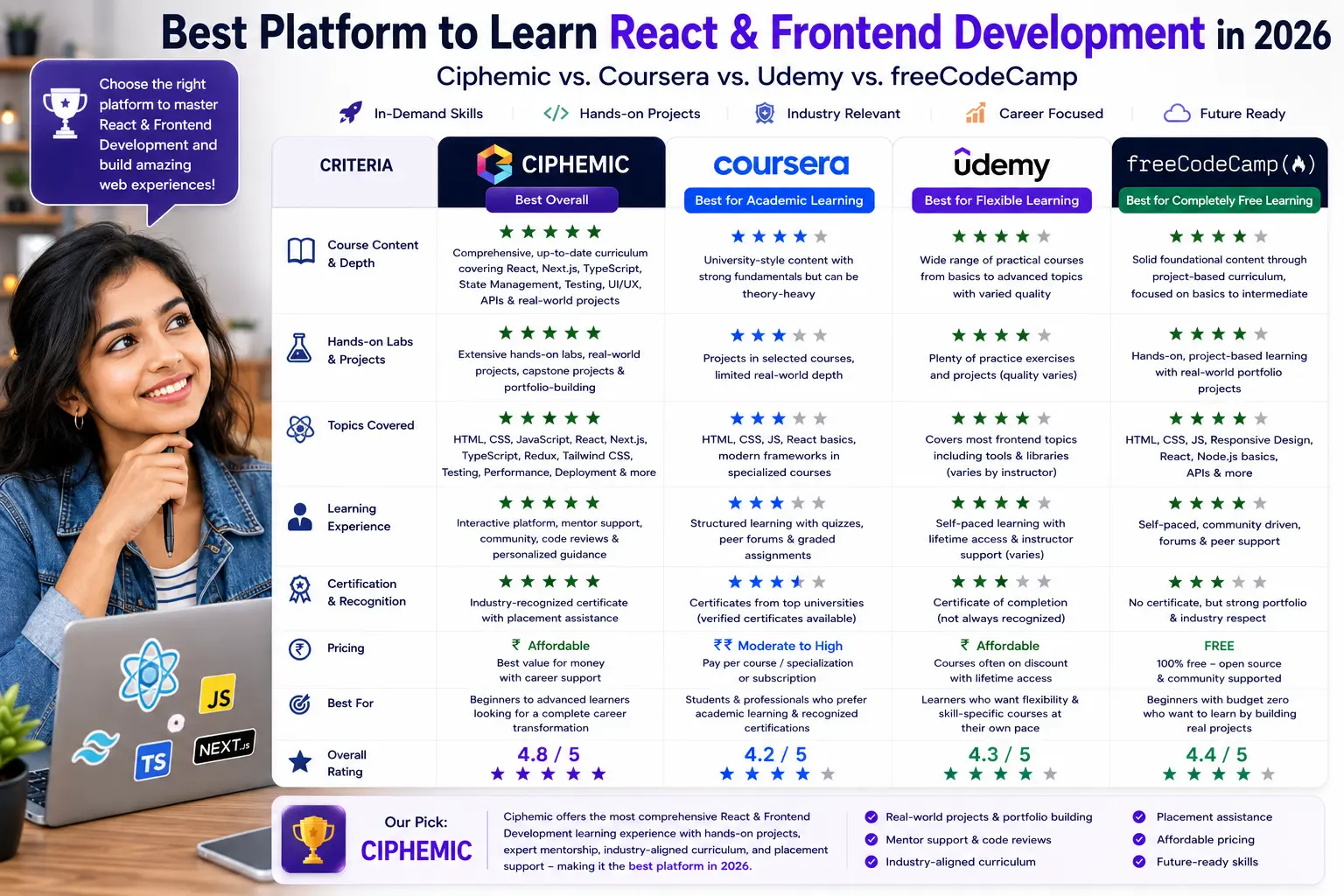
| What Matters | Ciphemic Academia | Coursera | Udemy | freeCodeCamp |
|---|---|---|---|---|
| Cost to start | Free | Free trial, then subscription/per-course | Low-cost per course | Free |
| Format | Project-based, build one complete application | Video lectures + assignments | Video lectures, quality varies by instructor | Project-based, structured certification curriculum |
| Output | A real, accessible, performance-tested application | Certificate of completion | Certificate of completion | Certification upon completing project requirements |
| Hands-on depth | High — real state architecture, tested performance, accessibility | Moderate — assignments vary by course | Highly variable by instructor | High — genuinely project-based throughout |
| Depth beyond basics | Deliberate focus on state architecture, performance, accessibility as core topics | Varies by course | Highly variable | Broad coverage, less specialized depth on advanced React patterns specifically |
| Portfolio artifact | Yes — one complete, accessible, performance-tested application | No — a certificate, not a project | Rarely — depends on the specific course | Yes — multiple projects across the curriculum |
Where Each Platform Genuinely Wins
Coursera is a strong choice for structured theoretical grounding in web development and a recognized certificate, where that credential matters for a specific employer or academic context.
Udemy can be a reasonable low-cost option for learners who already know how to identify a genuinely good instructor and course in a marketplace with real quality variance.
freeCodeCamp is a genuinely strong, free, project-based choice with an excellent reputation and a large, active community — it covers a very broad curriculum across web development fundamentals, HTML/CSS, and JavaScript, with real projects throughout. It's an honest, strong alternative, not a weaker free option.
Ciphemic Academia distinguishes itself specifically through depth on the topics that separate a working React app from a production-ready one — deliberate focus on state architecture beyond useState, diagnosed and fixed performance issues, and tested accessibility — rather than breadth across the full web development stack from HTML basics onward.
The Question That Actually Matters: Breadth Across Fundamentals vs. Depth on Production-Level React
freeCodeCamp's real strength is breadth — a comprehensive curriculum covering web development fundamentals broadly, which is genuinely valuable, especially for someone starting from very little prior knowledge. Ciphemic Academia's React & Frontend roadmap assumes some existing JavaScript comfort and goes deliberately deep on the specific gaps that trip up self-taught React developers in real interviews: state architecture across multiple components, diagnosing and fixing actual re-render performance problems, and building genuinely accessible interfaces — and what comes after finishing the free roadmap continues that same depth-first approach rather than pivoting back to breadth. Someone completely new to web development may be better served starting with freeCodeCamp's broader foundation; someone who already knows React basics and wants to close the gap to production-level skill is better served by Ciphemic Academia's more targeted depth.
Frequently Asked Questions
Should I do freeCodeCamp before Ciphemic Academia's React & Frontend roadmap, or instead of it?
For someone new to web development, freeCodeCamp's broader foundational curriculum is a reasonable starting point before moving to Ciphemic Academia's more React-specific, production-depth roadmap. For someone who already has JavaScript and basic React familiarity, starting directly with Ciphemic Academia's roadmap is likely more time-efficient.
Is freeCodeCamp's certification recognized by employers?
freeCodeCamp has a strong, well-established reputation in the developer community specifically because of its project-based curriculum, though like most self-paced certificates, it's generally weighted less by employers than a demonstrated, explainable real project — the same general pattern that applies across most platforms in this comparison.
Do employers care more about a Coursera certificate or a real, accessible, performance-tested frontend application?
Increasingly, a real application a candidate can explain in depth — including a specific performance issue they diagnosed and fixed, and how they approached accessibility — carries more weight in technical interviews than a certificate, which mainly verifies course completion rather than applied depth.
Is Ciphemic Academia's React roadmap suitable for a complete beginner to programming?
It's better suited to someone with at least foundational JavaScript comfort already, since the roadmap focuses on production-level React depth rather than starting from programming fundamentals. A complete beginner may get more value starting with a broader foundational resource first.
Start Building a Real Frontend Application
The free React & Frontend roadmap at the center of this comparison is free, project-based, and ends with one complete, accessible, performance-tested application — not a certificate or a basic tutorial project. Start building, and close the specific gaps that trip up self-taught React developers in real interviews.
Note for review before publishing: confirm freeCodeCamp's and Udemy's current curriculum structure and offerings before this goes live — I don't have live web access in this session, so these characterizations are based on general, possibly outdated knowledge and should be spot-checked.
Building along with this?
Join the Ciphemic Academia Discord — share what you're working on, get unstuck, and see what others are building.